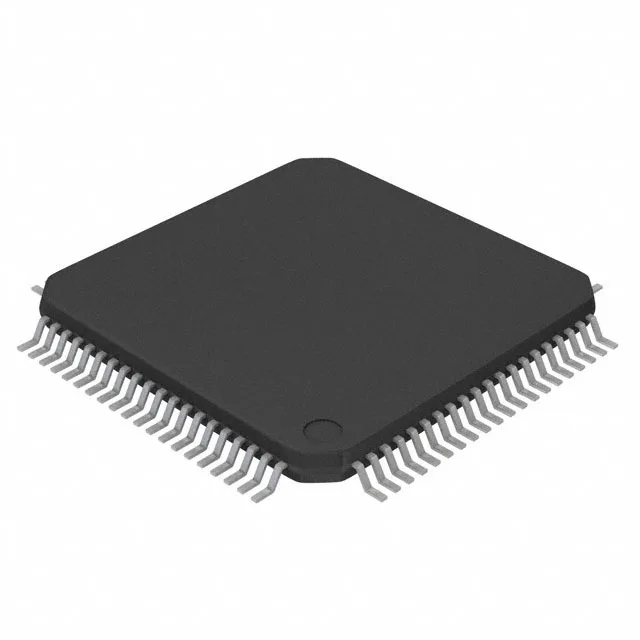
The distinguishing feature of this part is the on-chip LCD controller, which drives segment displays directly, alongside a brown-out detect, power-on reset, and a 12-bit ADC with 8 channels. Typical applications include handheld instruments, utility meters, and industrial panels where a low-power MCU drives a local display and handles sensor inputs over SPI or UART.
8 MHz core — adequate for display and sensor polling, not for heavy DSP
The 8 MHz clock limits throughput to control-loop and display-update tasks. If your firmware needs to run FFTs or high-rate filtering, this is not the core for it. For reading an ADC, updating a segment LCD, and communicating over UART or SPI at moderate baud rates, the speed is sufficient.
16 KB Flash, 512 B RAM — memory budget check before committing
The 16 KB program store and 512 B of RAM are tight. The LCD mapping table and a moderate protocol stack can fill the Flash quickly. The 256 B of additional memory in the program memory size line is for calibration or bootloader use.
The ROHS3 compliance is current. If you are qualifying this for a new production run, the lifecycle risk is low.
80-LQFP package — footprint and layout notes
The part comes in an 80-lead LQFP with a 12x12 mm body. The 48 I/O lines are accessible on the perimeter. Decoupling should follow the standard 100 nF per supply pair plus a bulk capacitor.