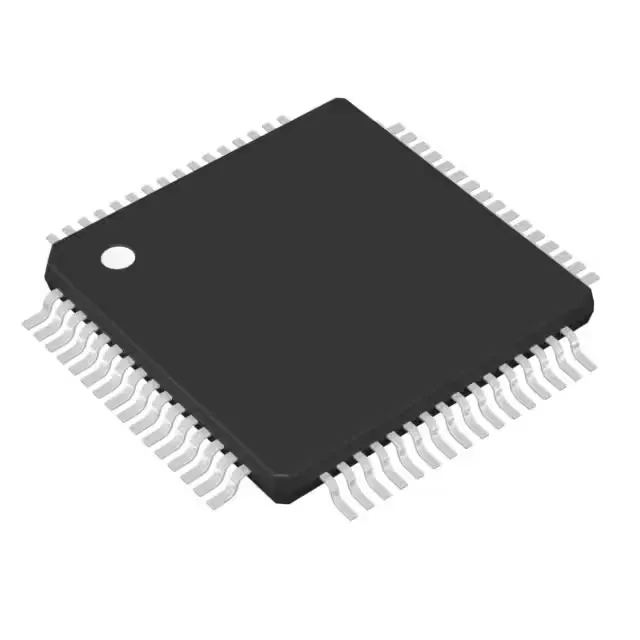
16-bit metering MCU with three sigma-delta ADCs
It integrates 32KB of Flash program memory, 1K x 8 of RAM, and the standout feature: three independent 16-bit sigma-delta analog-to-digital converters (A/D 3x16b) — a configuration rarely seen in this power class, purpose-built for energy metering, flow measurement, and precision sensor front-ends.
Three 16-bit sigma-delta ADCs — the reason to pick this part
The three 16-bit sigma-delta ADCs are the defining feature of the MSP430F427AIPMR. Each converter runs independently, allowing simultaneous sampling of three analog channels — critical for polyphase energy metering where voltage and current on each phase must be captured at the same instant. The 16-bit resolution gives 96 dB of dynamic range, enough to resolve microvolt-level signals from shunt resistors or current transformers without an external amplifier. For a design targeting Class 1 or Class 0.5 energy meters, this ADC block eliminates the separate AFE (analog front-end) IC, saving BOM cost and board area.
Peripheral set and connectivity for instrumentation
Beyond the ADCs, the peripheral set includes a brown-out detect/reset (BOR), power-on reset (POR), a watchdog timer (WDT), PWM outputs, and an LCD driver — the LCD segment drive is a legacy MSP430x4xx strength for direct glass connection without an external display controller. Connectivity covers SPI and UART/USART, sufficient for communicating with an external EEPROM, RF module, or host processor. With 14 general-purpose I/O pins in the 64-LQFP package, there is enough headroom for a few pushbuttons, LED indicators, and a serial debug interface alongside the analog inputs.
The 1.8V to 3.6V supply range means it can run directly from two alkaline cells, a single Li-ion, or a regulated 3.3V rail — no extra LDO needed if the battery voltage stays above 1.8V.