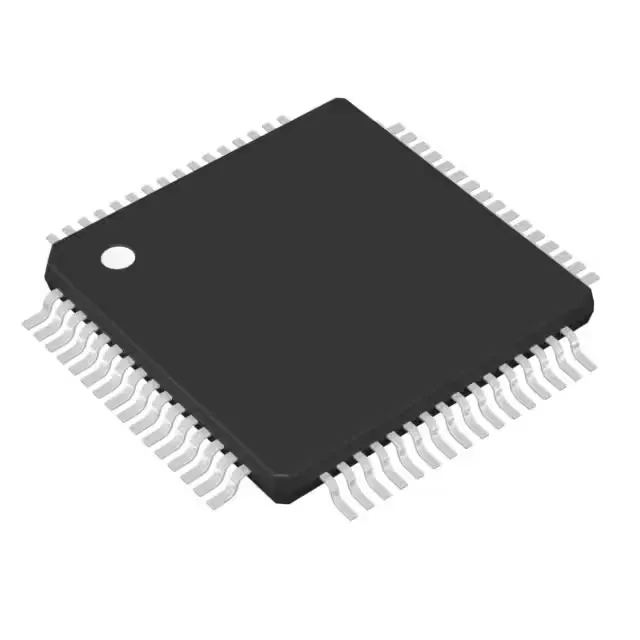
MSP430F427AIPM — 16-bit ultra-low-power MCU with integrated LCD drive and 16-bit sigma-delta ADC
What the 8 MHz clock and 32 KB Flash mean for the BOM
The 8 MHz core speed is modest by today's 32-bit standards, but that is by design — the MSP430 architecture is optimised for active-mode current in the microamp range at this clock, so the trade-off is throughput for battery life. The 1K x 8 RAM is tight: it forces careful allocation of stack, global variables, and ADC buffer space. Designs that need a large data buffer or a complex state machine should budget for external serial RAM or move to the higher-RAM MSP430F4xx variants.
Integrated 16-bit sigma-delta ADC and LCD driver — the differentiators
The three-channel 16-bit sigma-delta ADC is the headline analog peripheral on this part. It provides the resolution needed for energy metering (voltage and current sensing with a shunt or CT), weigh-scale load cells, or precision temperature measurements without an external ADC. The integrated LCD driver directly controls segmented glass displays, eliminating a separate display driver IC and reducing board area and BOM cost. The brown-out detect and POR circuits ensure reliable start-up and reset behaviour in noisy industrial environments, and the watchdog timer guards against firmware lock-ups in unattended installations.
Housed in a 64-pin LQFP (10x10 mm body, 0.5 mm pitch), the MSP430F427AIPM is a surface-mount device that routes easily on a two-layer PCB. The exposed pad is not present on this package variant — all thermal dissipation is through the leads, so keep ambient below 85°C in still air or provide airflow for continuous operation near the maximum rated current.