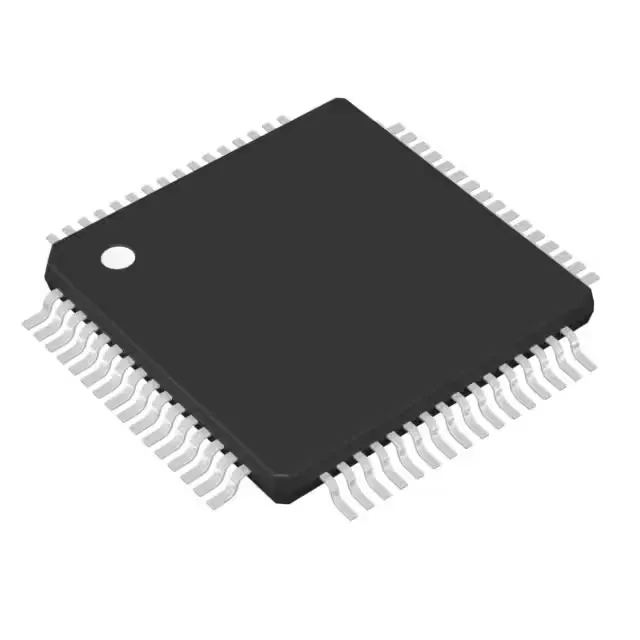
Core parametrics and the 512-byte RAM ceiling
The MSP430F425AIPMR: The 512-byte RAM is the tightest constraint in this part — the LCD frame buffer, call stack, and any interrupt service routine vectors share this pool. A firmware image that allocates a 64-byte display buffer and a 128-byte DMA ring buffer leaves 320 bytes for the C runtime stack, which is workable for a single-threaded foreground loop but leaves no headroom for a multitasking scheduler.
Sigma-delta ADC and LCD driver — the differentiating peripherals
Three independent 16-bit sigma-delta analog-to-digital converters, each with a built-in programmable gain amplifier (PGA). The SD16_A module samples at up to 1.2 ksps per channel in 16-bit mode; the effective resolution depends on the oversampling ratio and the external reference noise. For a 50/60 Hz energy-metering front-end, the 16-bit SD ADC delivers the dynamic range to resolve a 10 mV shunt drop without an external amplifier — the PGA handles gains of 1, 2, 4, 8, 16, and 32. The integrated LCD controller drives up to 160 segments (4-mux mode) or 128 segments (8-mux mode) without an external segment driver. The LCD RAM is part of the 512-byte main RAM — each segment bit consumes one byte of the shared pool. Enabling the full 160-segment display eats 160 bytes of RAM, leaving 352 bytes for the application. The contrast is software-adjustable via the VLCD pin bias resistor.
Supply range, temperature grade, and package footprint
The internal DCO (digitally controlled oscillator) runs from this rail and provides the 8 MHz system clock without an external crystal, though a 32.768 kHz watch crystal is needed for the auxiliary clock (ACLK) that drives the LCD and the watchdog timer in low-power modes. Packaged in a 64-pin LQFP (10x10 mm body, 0.5 mm pitch). The 64-LQFP breaks out all 14 GPIO pins plus the LCD segment and common lines. A 2-layer PCB can fan out the inner rows with 0.25 mm trace width and 0.25 mm spacing — the 0.5 mm pitch does not force a 4-layer board unless the design carries high-speed SPI above 4 MHz or sensitive analog traces near the SD ADC inputs.
The part is a current design-in candidate for new builds — no last-time-buy window has been announced.