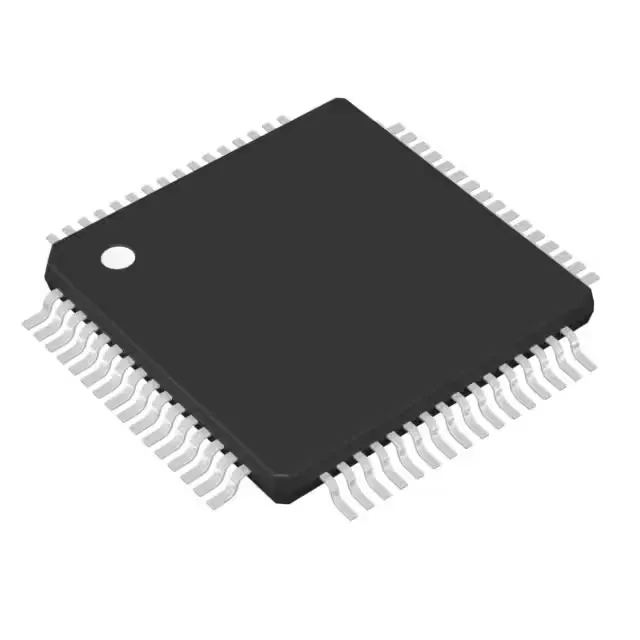
8 MHz core, 8 KB Flash — the metering and instrumentation MCU
The part is distinguished by its integrated LCD driver — a segment-level controller that drives a glass LCD panel directly — and three independent 16-bit sigma-delta ADCs for simultaneous multi-channel analog acquisition.
Integrated LCD driver — one less IC on the BOM
The on-chip LCD peripheral directly drives a segment-type LCD panel, eliminating a separate display controller or driver IC. This saves board area, reduces component count, and simplifies the interconnect — the display connects straight to the MCU pins without an external charge pump or bias generator in most cases. The peripheral handles the common and segment waveforms in hardware, so the firmware only writes display data to a buffer. For a panel-meter or blood-glucose-monitor design, this peripheral alone can justify the part selection over a general-purpose MCU that needs an external display driver.
Three 16-bit sigma-delta ADCs — simultaneous multi-channel sampling
Three independent 16-bit sigma-delta ADCs allow the MSP430F423AIPM to sample three analog channels simultaneously, each with its own programmable gain amplifier and digital filter. This is the key spec for energy metering (voltage and current per phase) or multi-sensor data acquisition where phase alignment between channels matters. Each converter runs independently, so the firmware can trigger a conversion on one channel without disturbing the others. The 16-bit resolution provides a theoretical dynamic range of about 96 dB, sufficient for most industrial sensor interfaces without an external ADC.
TI continues to support the MSP430x4xx family with development tools, application notes, and firmware libraries.
Supply range and I/O — battery-friendly and flexible
The 14 general-purpose I/O pins are 5 V tolerant on most MSP430 devices, though the evidence does not specify tolerance here — verify against the datasheet I/O structures for the specific pin.