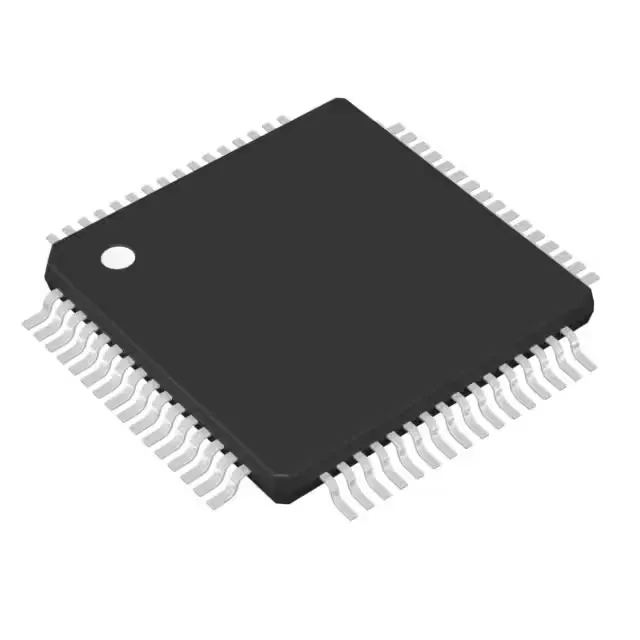
Texas Instruments MSP430F413IPMR — Microcontrollers & Processors (MCU / MPU / DSP)

TI MSP430F413IPMR 16-bit MCU, 8KB Flash, 8MHz, 64-LQFP

MPNMSP430F413IPMR
Active

Texas Instruments MSP430x4xx MSP430F413IPMR, 16-bit MSP430 CPU16 MCU, 8MHz, 8KB Flash, 256 x 8 RAM, 48 I/O, 64-LQFP, -40°C to 85°C, 1.8V to 3.6V supply.

$5.0000Ref. price · indicative, final on quote
Packaging64-LQFP
RoHSROHS3 Compliant
SeriesMSP430x4xx
Independent supplier — new & surplus stockAuthenticity-screened · ESD-safe packingListing updated Aug 2026

Specifications

MSP430F413IPMR specifications
ParameterValue
SeriesMSP430x4xx
MountingSurface Mount
Oscillator typeInternal
Program memory typeFLASH
Voltage - supply (Vcc (Vdd))1.8V ~ 3.6V
Operating temperature-40°C~85°C(TA)
Speed8MHz
PackageTape & Reel (TR); Cut Tape (CT)
RAM size256 x 8
Core size16-Bit
PeripheralsBrown-out Detect/Reset, LCD, POR, PWM, WDT
Number of i (O)48
Core processorMSP430 CPU16
Case64-LQFP
Data convertersSlope A/D
Program memory size8KB (8K x 8 + 256B)

Product details

8 KB Flash and 256 B RAM — sizing the firmware budget

With 8 KB of Flash and 256 bytes of RAM, the MSP430F413IPMR is sized for single-function control loops — think a thermostat with a segment LCD, a flow meter, or a simple data-logger front end. The 256-byte RAM is the tightest constraint: it limits the call stack depth and any buffering. For designs that need more headroom, the MSP430x4xx family scales up to 60 KB Flash and 2 KB RAM in the same 64-LQFP footprint.

Integrated LCD driver — BOM simplification

The on-chip LCD driver supports up to 4-mux or 8-mux segment LCDs, driving the glass directly without an external HT1621 or similar controller. This saves about $0.30 to $0.50 in BOM cost and frees up board area and I/O pins. The driver runs from the internal oscillator or an external low-frequency crystal, and the MCU can enter low-power modes while the LCD refresh continues — a common trick to keep a clock or status display alive at single-digit microamp draw.

At 3.0 V the core draws roughly 300 µA/MIPS in active mode and under 2 µA in standby with the LCD running, though those figures are typical — budget for the worst-case column when sizing the battery.

Frequently asked questions

Can MSP430F413IPMR replace MSP430F413IPM?

Yes, the MSP430F413IPMR is functionally identical to the MSP430F413IPM — same die, same 64-LQFP package, same 8 KB Flash and 256 B RAM. The only difference is the shipping medium: the IPMR suffix indicates Tape & Reel, while the IPM suffix typically ships in trays or tubes. A board designed for the IPM will accept the IPMR without any change.

Is MSP430F413IPMR RoHS compliant?

Yes, the MSP430F413IPMR is ROHS3 compliant, meeting the current EU RoHS exemption rules. No conflict with global regulatory requirements for commercial and industrial products.

What is the difference between MSP430F413IPMR and F280041PZQR?

These are not functional alternatives. The F280041PZQR is a 32-bit C2000 C28x MCU running at 100 MHz with 12-bit ADCs and CAN/LIN interfaces, designed for real-time motor control and power conversion. The MSP430F413IPMR is a 16-bit ultra-low-power MCU at 8 MHz with an integrated LCD driver, targeting battery-powered metering and display applications. They share no pinout, peripheral set, or software compatibility.

Can MSP430F413IPMR be used in battery-powered applications?

The ultra-low-power architecture, combined with the ability to keep the LCD running in standby mode at single-digit microamp draw, makes it well-suited for battery-powered instrumentation and portable display panels.