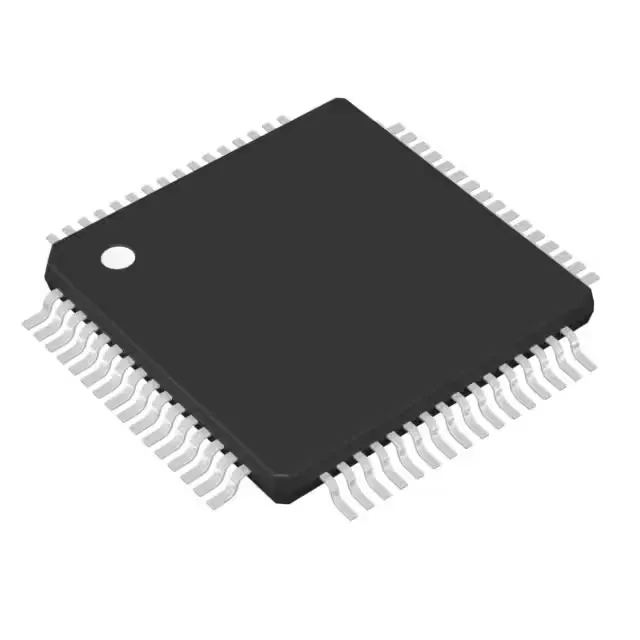
Texas Instruments MSP430F413IPM — Microcontrollers & Processors (MCU / MPU / DSP)

Texas Instruments MSP430F413IPM 16-bit MCU, 8KB Flash

MPNMSP430F413IPM
Active

Texas Instruments MSP430x4xx MSP430F413IPM, 16-bit MSP430 CPU16 MCU, 8 MHz, 8KB Flash, 256 x 8 RAM, 48 I/O, 1.8 V to 3.6 V, -40°C to 85°C, 64-LQFP.

$6.0000Ref. price · indicative, final on quote
Packaging64-LQFP
RoHSROHS3 Compliant
SeriesMSP430x4xx
Independent supplier — new & surplus stockAuthenticity-screened · ESD-safe packingListing updated Aug 2026

Specifications

MSP430F413IPM specifications
ParameterValue
SeriesMSP430x4xx
MountingSurface Mount
Oscillator typeInternal
Program memory typeFLASH
Voltage - supply (Vcc (Vdd))1.8V ~ 3.6V
Operating temperature-40°C~85°C(TA)
Speed8MHz
PackageTray
RAM size256 x 8
Core size16-Bit
PeripheralsBrown-out Detect/Reset, LCD, POR, PWM, WDT
Number of i (O)48
Core processorMSP430 CPU16
Case64-LQFP
Data convertersSlope A/D
Program memory size8KB (8K x 8 + 256B)

Product details

8 KB Flash and 256 bytes RAM — sizing the firmware and data buffers

The 8 KB Flash (8K x 8 plus 256 bytes) and 256 x 8 RAM are the memory ceiling for this part. For a typical LCD-based utility meter, the firmware image for the MSP430 CPU16 core with the LCD driver library and a simple protocol stack fits comfortably inside 8 KB, but a design that adds over-the-air update staging or a larger lookup table will bump against the limit. The 256-byte RAM is the tighter constraint — it holds the display buffer, a few sensor readings, and a small call stack, but leaves no room for a large data cache or multi-packet communication buffers. If the application needs more than a few dozen bytes of working memory, step up to a higher-density MSP430x4xx variant.

Integrated LCD driver and slope A/D — what they save on the BOM

The on-chip LCD controller drives a segment LCD directly, eliminating a separate display driver IC and its associated passives. The slope A/D converter provides a single-channel ADC without an external analog front-end, suitable for reading a resistive sensor or a battery voltage. Together, these two peripherals can reduce the total component count by three to five ICs and their decoupling capacitors, which is the main reason this part appears in cost-sensitive, space-constrained metering and handheld instruments.

Package and footprint — 64-LQFP 10x10 mm

The supplier device package is 64-LQFP (10x10). The part is supplied in tray form, not Tape & Reel, which matters for automated pick-and-place — confirm the feeder setup if your line expects reeled parts.

Frequently asked questions

What is the difference between MSP430F413IPM and MSP430F413IPMR?

The difference is the shipping medium. The MSP430F413IPM is supplied in tray form, while the MSP430F413IPMR is supplied in Tape & Reel. The silicon, package, and electrical specifications are identical.

Can MSP430F413IPM be replaced by MSP430F413?

The base product number MSP430F413 is the same silicon; the suffix IPM or IPMR designates the package and shipping medium. A part marked MSP430F413 without a suffix is not a standard TI ordering code — always use the full order code MSP430F413IPM or MSP430F413IPMR for a valid replacement.

What is the listed speed of MSP430F413IPM?

The MSP430F413IPM runs at 8 MHz. This clock rate, combined with the MSP430 CPU16 core, delivers enough throughput for LCD refresh and slope A/D conversion in metering and sensor applications.