What the 8 KB flash and 512 B RAM mean for your firmware
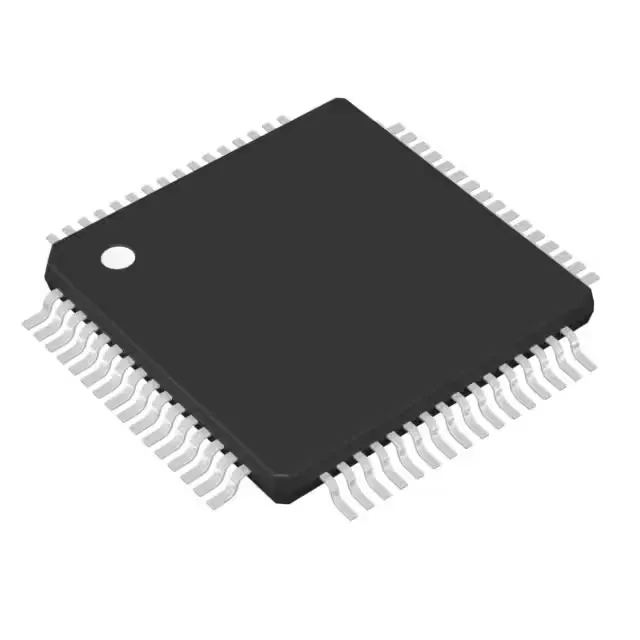
The MSP430F4132IPM: The 8 KB flash holds a modest application with a real-time clock, a few ADC channels, and a UART or I²C communication stack; the 512 B RAM handles a couple of 100-byte buffers and a small call stack. If your firmware needs to buffer large data packets or run a full TCP/IP stack, you will hit the ceiling — this part is sized for deterministic, low-complexity control tasks. The 8 MHz CPU16 core keeps the clock rate low enough that the flash can run without wait states at 1.8 V, so the MIPS-per-milliamp ratio stays favourable for battery-powered metering endpoints.
Peripheral set that shrinks the BOM
An integrated LCD driver drives up to 128 segments directly — no external display controller needed for a 4x20 character or simple graphic panel. The 8-channel 10-bit ADC covers analog inputs like temperature sensors, current shunts, or potentiometer knobs without an external converter. The comms suite includes I²C, SPI, UART/USART, LINbus, and IrDA — enough to talk to an external EEPROM, a radio module, or a host controller over a single bus. The 56 I/O lines leave room for a keypad matrix and status LEDs alongside the display. Brown-out detection and POR are on-chip, so the reset circuit is just a pull-up resistor and a decoupling cap — no external supervisor IC.
Package and board-fit for hand assembly
The exposed pad on the bottom is not a thermal pad here (the LQFP has no paddle), so standard QFP rework techniques apply.
Temperature grade and deployment context
The internal oscillator eliminates the external crystal for many applications, though the accuracy is ±1% typical — keep an external crystal or resonator if you need a precision timebase for the RTC.