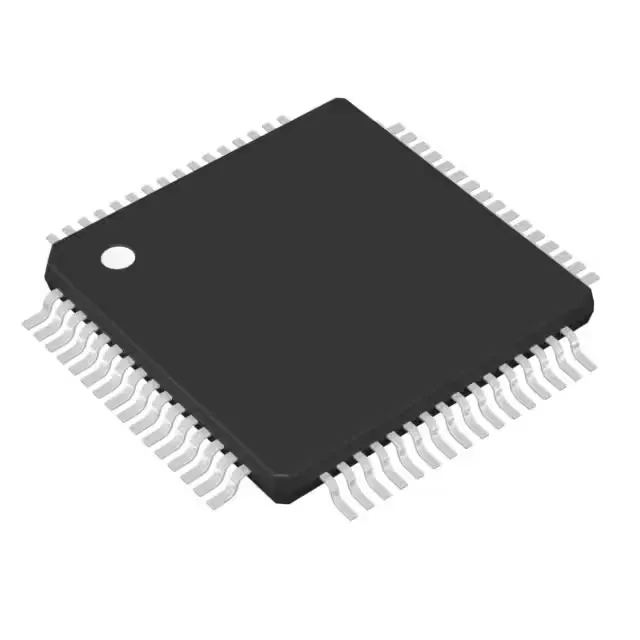
16 MHz MSP430 core with 32 KB flash — what the clock and memory budget mean for a control loop
The MSP430F247TPM runs the 16-bit MSP430 CPU16 at 16 MHz. The flash controller inserts wait states above 8 MHz, so the effective instruction throughput at 16 MHz is about 8 MIPS — enough for a sensor-fusion loop or a Modbus RTU poll cycle, but not for real-time FFT or high-speed PID at loop rates above 10 kHz. 32 KB of program flash plus 4 KB of SRAM fits a moderate application: a FreeRTOS or TI-RTOS kernel with a few tasks, a UART command parser, and a 12-bit ADC scan of 8 channels. The 256-byte information memory segment holds calibration constants or a bootloader signature without eating into the main flash.
64-LQFP footprint and board integration
Fanning out all 48 I/O plus the supply and oscillator pins typically requires a 4-layer board — two layers for signals, a ground plane, and a power plane. There is no exposed thermal pad; the junction-to-ambient thermal resistance relies on the leadframe and the copper pour on the outer pins.
Active lifecycle and compliance documentation
It is RoHS3 compliant, meaning the solder finish and package materials meet the latest EU restriction directive without exemptions.