The 92 KB Flash (organized as 92K x 8 plus 256 bytes) holds application code, a bootloader, and calibration tables. For a typical control loop with PID coefficients, communication stack, and a few hundred lines of application logic, this is a comfortable fit — you are not squeezing into a 32 KB part. The 8 KB RAM handles runtime variables, stack, and communication buffers; designs with large look-up tables or multi-packet UART buffers should budget carefully, because 8 KB disappears fast with a 1 KB DMA buffer and a 2 KB stack.
At 16 MHz, the MSP430 CPU16 executes most instructions in one or two clock cycles, so a 1 kHz control loop has roughly 8,000 to 16,000 instruction cycles to complete its work — enough for a PID calculation, ADC read, and UART transmit without pushing the timing margin. If your loop runs at 10 kHz or you are bit-banging a protocol, the 16 MHz ceiling becomes the constraint.
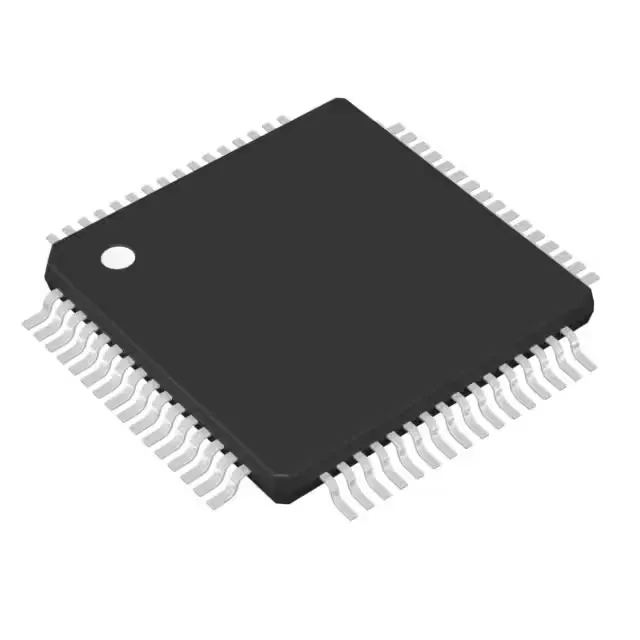
64-LQFP package — rework and footprint
The MSP430F2xx series has broad installed base, so supply continuity is stable — not a niche part with a short production window.