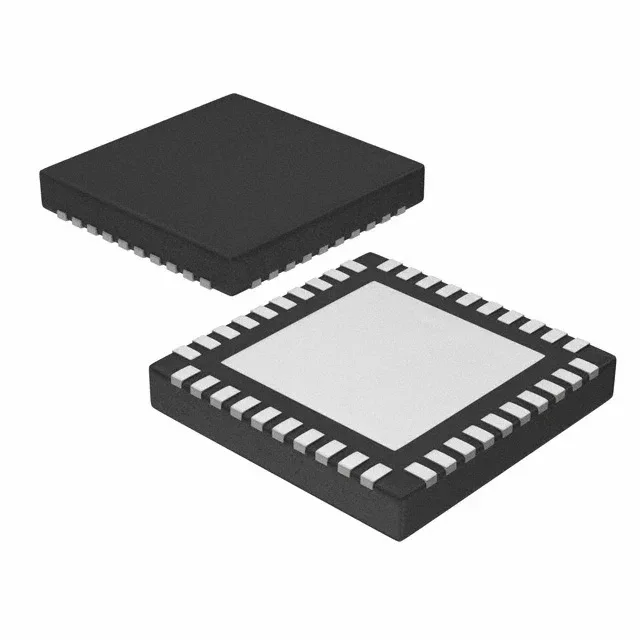
Texas Instruments lists the MSP430F2350IRHAR as Active, meaning the die, mask, and assembly line are still running. For a BOM that already qualifies this part, there is no forced migration horizon — the supply chain risk here is allocation, not obsolescence.
16 MHz MSP430 CPU with 16 KB flash — sizing the firmware envelope
The 16-bit MSP430 CPU16 core runs at 16 MHz. That clock ceiling, combined with the single-cycle multiply-accumulate hardware in the MSP430X architecture, sets the throughput for sensor fusion loops, PID updates, and protocol framing. The 16 KB flash holds the application code plus a 256-byte information memory segment for calibration constants or bootloader flags. 2 KB of RAM is the working data space — enough for a modest RTOS heap, a few 256-byte buffers, and the stack. If the firmware exceeds this, the next step up in the MSP430F2xx family adds flash without changing the pinout.
Peripheral set and I/O — what is on the die
The MSP430F2350IRHAR integrates a brown-out detector and power-on reset (BOR/POR), a watchdog timer, and a PWM timer. For serial communication it carries I2C, SPI, UART/USART, IrDA, and LINbus — all on the same silicon. 32 general-purpose I/O lines are available, though some share function with the analog comparator or the slope A/D converter. The internal oscillator trims to ±1% accuracy across temperature, so an external crystal is optional for UART baud-rate generation.
Package, footprint, and thermal land
The 40-VFQFN with exposed pad has a 6×6 mm body and a 0.5 mm pitch. Without that, the junction-to-ambient thermal resistance rises above the datasheet's 32 °C/W typical, and the 85 °C ambient limit becomes harder to hold under continuous load. The tape-and-reel packaging means the parts arrive on 13-inch reels; cut-tape quantities are available for prototyping.
Supply rail and temperature grade
ROHS3 compliance means no exemptions for lead in solder or surface finishes — the part is compatible with lead-free reflow profiles up to 260 °C peak.