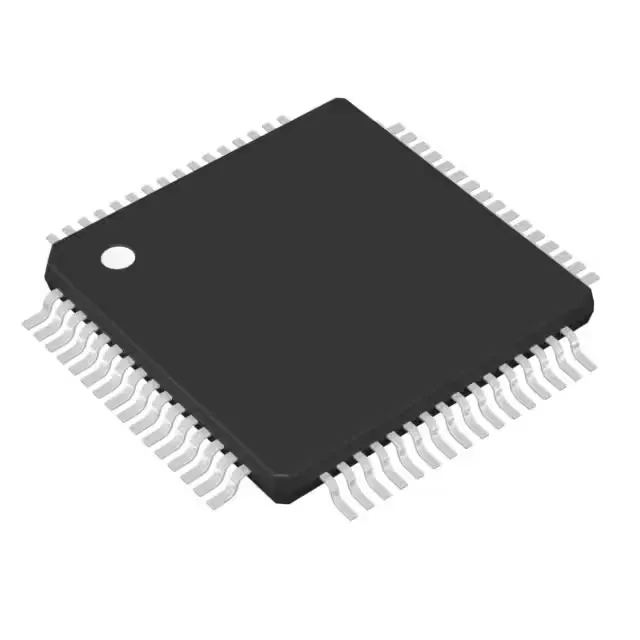
8 MHz core, 32 KB Flash, 5 KB RAM — memory headroom for mixed-signal control
The MSP430F1610IPM is a 16-bit MCU from the MSP430x1xx family, clocked at 8 MHz with 32 KB of program Flash and 5 KB of RAM. That RAM allocation — 5K x 8 — is the working memory for the stack, buffers, and real-time variables; for a sensor-fusion or data-logging application, budget the FIFO and DMA buffers against this ceiling before committing the BOM line. The 32 KB Flash (32K x 8 plus 256 bytes of information memory) stores the application code and calibration constants. The 256-byte segment is typically used for device-unique trim values or bootloader parameters — it is not part of the general-purpose program space, so the usable code footprint is the full 32 KB.
Analog and digital peripheral mix — 8-channel ADC, dual DAC, 48 GPIO
The ADC samples eight external inputs sequentially through a single S/H circuit; if the application requires simultaneous sampling of two channels, an external S/H or a second ADC channel on another device is needed. The dual DACs can generate independent analog outputs — useful for setting reference voltages or driving analog actuators without external converters. Forty-eight digital I/O lines are available, with the port mapping configurable for the on-chip peripherals: I²C, SPI, and UART/USART serial interfaces share pins with GPIO. The DMA controller moves data between peripherals and memory without CPU intervention, which matters for streaming ADC readings or servicing a UART buffer at full 8 MHz throughput.
Active production — no end-of-life watch needed
Sourced through authorized and independent distribution channels.