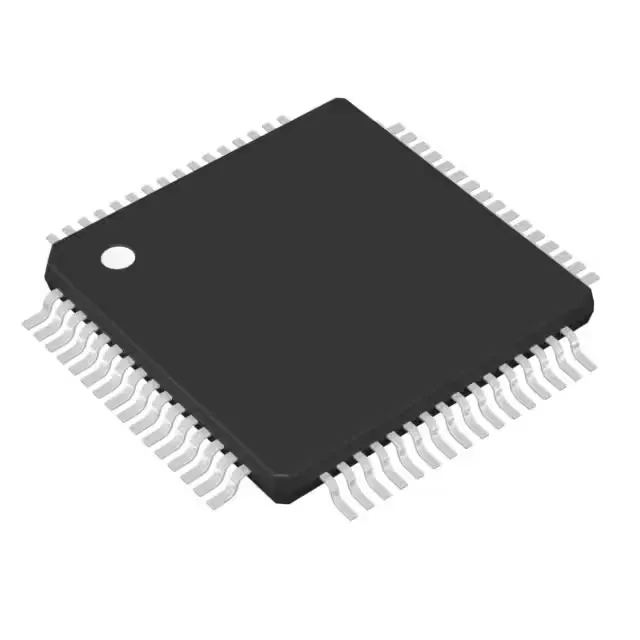
16-bit ultra-low-power MCU with integrated 12-bit ADC
The MSP430F149IPM: SPI and UART/USART serial interfaces are available for connecting to external sensors, radios, or displays.
The 8 MHz clock rate is modest by today's standards, but the MSP430 architecture is designed to deliver useful work per cycle at very low current draw. For a polling loop or a periodic sensor readout, the CPU can spend most of its time in a low-power sleep mode and wake only when the ADC or a timer interrupt fires.
Memory sizing: 60 KB Flash, 2 KB SRAM
The 60 KB Flash (organized as 60K x 8 plus 256 bytes) provides enough code space for a moderate firmware stack — a real-time operating system kernel, communication protocol, and sensor calibration tables all fit. The 2 KB SRAM is the tighter resource; data buffers and stack usage need careful budgeting, especially if you are handling multiple UART packets or a display frame buffer. For data-logging applications, external serial EEPROM or FRAM is a common companion.
Integrated 8-channel 12-bit ADC
The on-chip ADC is a 12-bit successive-approximation converter with eight analog inputs. That eliminates an external ADC chip for designs that need to digitise a handful of sensor signals — thermocouples, strain gauges, potentiometers, or current shunts. The 12-bit resolution (4096 counts) is adequate for 0.1% accuracy in most industrial and instrumentation applications. The ADC shares pins with digital I/O, so the firmware must configure the port mux on the channels used.
For a production BOM, this removes the urgency to qualify a substitute or stockpile inventory.