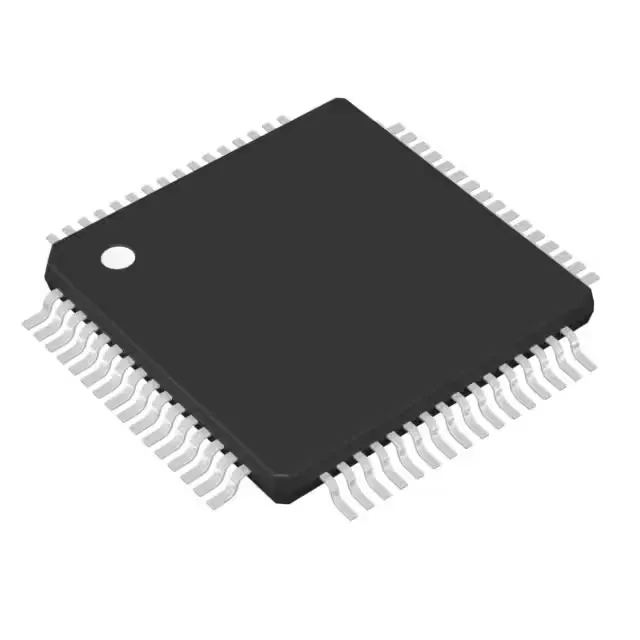
MSP430F1491IPM — 16-bit ultra-low-power MCU for industrial sensing and control
The part is designed for battery-operated and industrial applications where low power consumption is the primary selection criterion — the MSP430 architecture draws microamps in standby and wakes quickly to handle sensor reads or communication packets.
The 8 MHz clock rate sets a deterministic throughput ceiling. For a 16-bit RISC-like core executing most instructions in a single cycle, that yields roughly 8 MIPS. The trade-off is that the same 8 MHz clock keeps dynamic current low, which is the whole point of the MSP430 family: you run the CPU just fast enough to service the event, then drop back to sleep.
The 60 KB Flash (organized as 60 K × 8 plus 256 bytes of information memory) is generous for a mid-range MSP430. It can hold a full sensor-fusion library, a communication stack (e.g., a simple Modbus RTU or a custom binary protocol), and a bootloader. The 2 KB SRAM is the tighter resource — it must accommodate the call stack, interrupt vectors, and all runtime data buffers. If your application uses large lookup tables or multi-packet FIFOs, the 2 KB ceiling will force either external SRAM or a move to a higher-RAM variant in the MSP430x1xx family.
Package and I/O — 64-LQFP with 48 accessible pins
The MSP430F1491IPM comes in a 64-LQFP (10x10 mm) body with 0.5 mm pitch — a standard, inspectable footprint that reflows reliably with a normal leaded or lead-free profile. Of the 64 pins, 48 are general-purpose I/O, which is enough to interface a parallel LCD, a key matrix, several sensors, and a serial bus simultaneously without a port expander.
The ROHS3 compliance covers EU and global regulatory requirements for lead-free assembly.