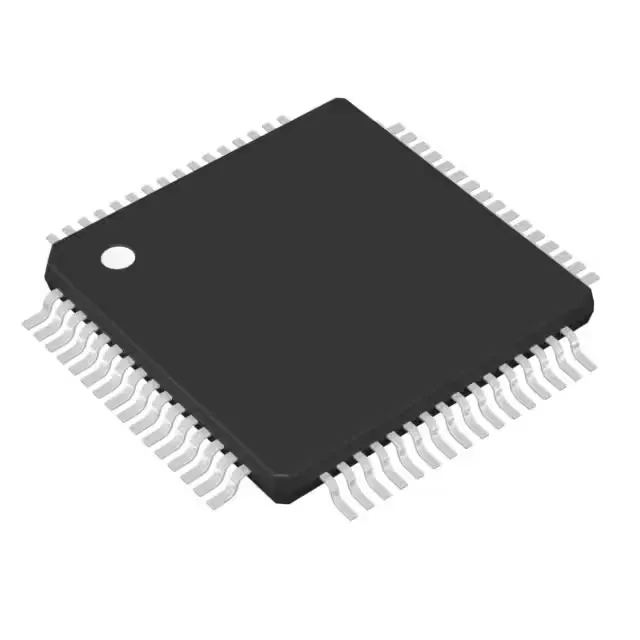
The MSP430F1481IPM: It runs at 8 MHz and carries 48 KB of program Flash plus 2 KB of RAM — enough for moderate sensor-fusion, control-loop, or human-interface tasks where power efficiency matters more than raw throughput. With 48 general-purpose I/O lines, SPI and UART/USART connectivity, and on-chip peripherals including POR, PWM, and WDT, it covers the typical I/O and timing needs of a low-power embedded controller.
The 8 MHz clock is the part's headline performance spec. It places the MSP430F1481IPM in the low-power, moderate-throughput tier of the MSP430 family — not the high-speed class of the F280041PZQR (C28x core at 100 MHz). For a design that needs a few thousand instructions per second on a sensor loop or a simple control algorithm, 8 MHz is ample and keeps dynamic current low. If your application requires real-time digital signal processing or fast communication at multi-megabit rates, the 8 MHz ceiling will be the bottleneck; you would step up to a higher-speed MSP430 variant or a C2000 part.
48 KB of program Flash (48K x 8 plus 256 bytes) and 2 KB of RAM define the firmware envelope. That is enough for a moderate sensor hub, a PID control loop with a few tables, or a simple user interface with a small display buffer.
The 64-LQFP package (10x10 mm) is a common surface-mount footprint with 48 usable I/O.
The part is ROHS3 compliant. For BOM planning, this part presents no near-term obsolescence risk, and it can be dual-sourced through the independent channel as needed.