256 KB Flash for a Bluetooth stack — the headroom question
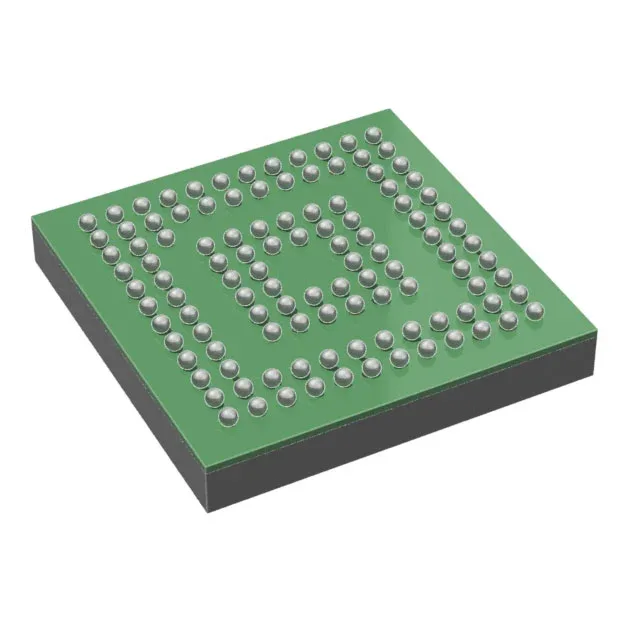
That Flash budget is the first thing to size: a Bluetooth stack (TI's own or a third-party BLE stack) typically consumes 80–120 KB, leaving 130–170 KB for the application layer. The 16 KB RAM handles the stack's GATT database and connection buffers, but if your application needs large data arrays or multiple simultaneous connections, you'll be counting bytes. The part integrates I²C, SPI, UART, and IrDA serial interfaces, giving peripheral routing options without external bridge chips. The 87 GPIOs in the 113-NFBGA package provide plenty of pinout for sensor arrays or display interfaces, but the fine-pitch BGA (0.5 mm ball pitch typical for 7x7 mm NFBGA) demands careful PCB layout and controlled-impedance traces for the RF section if the Bluetooth radio is active.
Supply range and temperature — where it works and where it doesn't
This makes the part viable for battery-powered Bluetooth peripherals like wearables, beacons, and wireless sensor nodes. If your application lives inside a vehicle cabin or engine bay, you'll need an AEC-Q100 qualified part — this one isn't listed as such.
Package reality: 113-NFBGA — what it means for assembly and rework
The 113-ball NFBGA (7x7 mm) is a fine-pitch BGA. That buys you 87 I/O in a small footprint, but it also drives the PCB fab and assembly process: you need micro-via capable layers, solder mask defined pads, and X-ray inspection for void detection. Rework is possible with a BGA rework station, but not field-service friendly. If your prototype run is hand-assembly, consider a socketed evaluation module first.
Lifecycle status — no LTB clock ticking
That said, the MSP430BT5190 base part number is a specific Bluetooth-optimized variant within the MSP430 family; if TI consolidates its Bluetooth MCU roadmap in the future, a PCN could appear. For now, the supply channel is standard distribution.