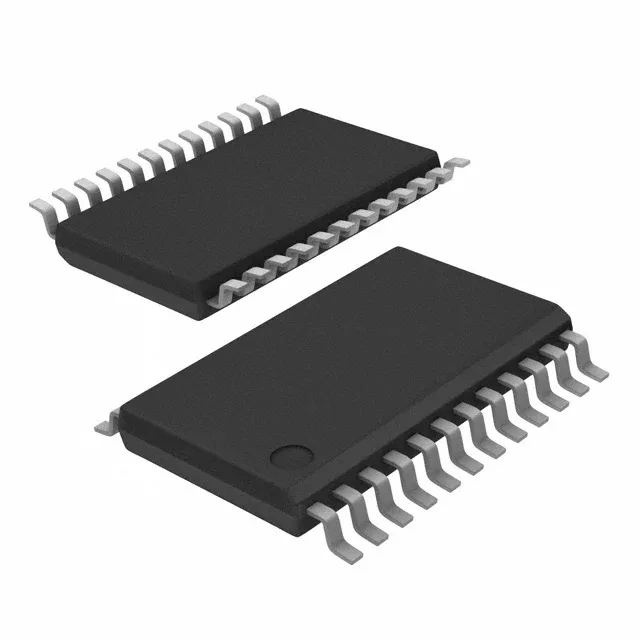
MSP430AFE253IPW — 16-bit MCU with integrated 24-bit sigma-delta ADC for precision sensing
Connectivity includes SPI and UART/USART for host communication. The 11 GPIO lines handle local control and status. The 24-TSSOP package (4.40 mm width) suits space-constrained mixed-signal PCBs.
The three 24-bit sigma-delta ADCs are the reason to pick this MSP430 variant over the larger MSP430F2xx family. The 24-bit resolution gives around 16.7 million counts, which for a 100 mV full-scale input yields sub-microvolt per-count steps — adequate for class 0.5 energy meters or load-cell readouts. The 12 MHz CPU has enough headroom to run the digital filter and a simple communication stack without dropping samples.
16 KB Flash — firmware budget check
With 16 KB of Flash, the firmware footprint is the first constraint to check. The MSP430 instruction set is efficient, but a full metering library with calibration tables and a Modbus stack can push past 12 KB. Leave room for field updates if the application uses the Flash as pseudo-EEPROM. The 512 x 8 RAM is tight for buffering — plan for streaming ADC data directly to the host via UART rather than accumulating large blocks.
The base product number MSP430AFE253 shares the same die across the TSSOP and other package options, so a pin-compatible variant is available if the 24-TSSOP footprint needs to be respun.
Package and mounting — 24-TSSOP layout notes
The 24-TSSOP package (0.173" body width, 4.40 mm) is a surface-mount device with a 0.65 mm lead pitch. The exposed pad is not present on this package variant, so thermal dissipation relies on the leads. For decoupling, place a 100 nF ceramic within 2 mm of each Vcc/Vss pair. The SPI and UART pins are on the same port, so the layout should keep the digital communication traces away from the analog input pins to preserve the 24-bit ADC noise floor.