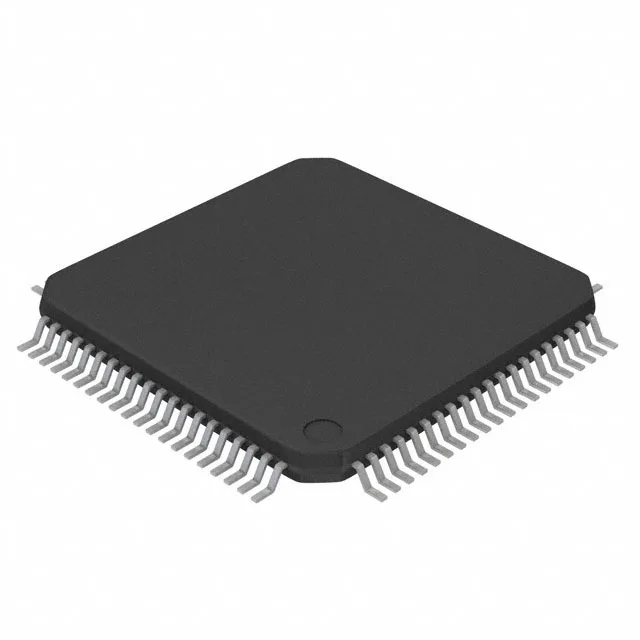
What this MSP430x4xx brings to a low-power BOM
It runs at 8 MHz and packs 48 KB of program Flash and 2 KB of RAM, enough for sensor fusion, metering, or display-control firmware that doesn't need a Cortex-M class throughput. The integrated 12-bit ADC with 12 channels and a dual 12-bit DAC lets you handle analog inputs and outputs without external converters, shrinking the analog BOM. This is a part you'd specify for a battery-operated panel meter, a flow totalizer, or a portable medical monitor where every microamp of sleep current matters.
8 MHz ceiling — sizing the performance envelope
The 8 MHz core speed sets a firm upper bound on throughput. That is enough for polling a 12-bit ADC at a few kilo-samples per second, driving a segment LCD, and handling UART or SPI traffic without a scheduler. It is not a part for real-time FFT, motor field-oriented control, or camera sensor readout. If your algorithm needs more than about 4 MIPS of sustained work, this is the wrong MCU tier — you want the MSP430F5xxx or a Cortex-M0+ at 48 MHz.
The 48 KB program Flash and 2 KB RAM are the memory envelope you design to. The Flash is enough for a moderate application stack: a bootloader, a Modbus RTU or custom serial protocol, an LCD driver, and a few hundred lines of calibration and state-machine code. The 2 KB RAM is tight for buffering — expect to manage UART receive buffers in Flash or use the DMA to move data directly to peripherals. If your application needs a large lookup table or a frame buffer, budget for external SPI SRAM or a denser sibling.
Industrial temperature range — where it goes
The 80-LQFP package with 48 I/O gives you enough pins for a parallel LCD bus, a row of buttons, and a few external interrupt lines, all in a surface-mount footprint that reflows without special handling.
If you are dual-sourcing or building a second-source plan, the pin-compatible MSP430A078IPN (48 KB Flash variant with slightly different peripheral set) is the natural cross-shop candidate within the same family.