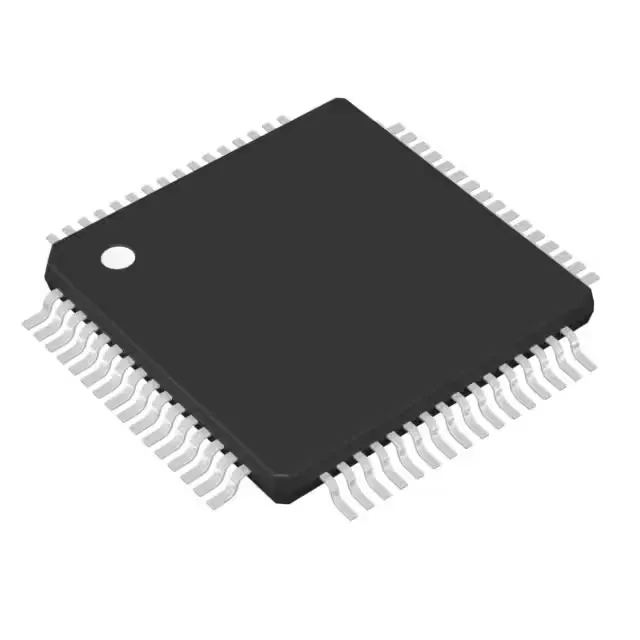
8 MHz 16-bit core — the throughput ceiling for this MSP430 variant
The MSP430A002IPM runs a 16-bit MSP430 CPU at 8 MHz — this is the instruction-cycle limit, not a turbo or overclock headroom. For a sensor node polling an ADC at 1 kHz and logging via UART, the 8 MHz clock leaves enough margin for the interrupt handler and main loop without hitting the ceiling. 32 KB of on-chip flash (32K x 8 plus 256 bytes) and 1 KB of RAM define the firmware and runtime data budget. The flash holds the application code and constant tables; the 1 KB RAM must cover stack, global variables, and ADC buffers — tight for a complex state machine but workable for a single-loop sensor controller.
Peripheral set — serial interfaces and analog capture
On-chip peripherals include POR (power-on reset), PWM generation, and a watchdog timer — enough for basic timing and fault recovery without external supervisor ICs. The 8-channel 12-bit ADC samples analog inputs at up to 200 ksps (typical for the MSP430 family), suitable for temperature, pressure, or current-sense signals. Serial connectivity covers SPI and UART/USART — no I2C, USB, or CAN on this die. For a design that needs I2C sensors, an external bit-bang or a level-shifter plus software UART is required. The 48 I/O pins give flexibility for parallel displays or keypad matrices.
Industrial temperature grade and supply range
Rated for -40 to +85 °C ambient (TA), this MCU operates in factory-floor enclosures, outdoor telecom cabinets, and engine-bay-adjacent electronics without active cooling.
64-LQFP package — board-fit and soldering
Housed in a 64-lead LQFP with a 10x10 mm body, the 0.5 mm pitch demands a controlled reflow profile and a clean solder mask. The exposed pad on the bottom side (if present — not confirmed in the spec) would require a thermal via array for heat sinking. Store the reels dry: LQFP packages are moisture-sensitive, and a bake cycle before reflow is mandatory if the moisture barrier bag is breached.