These two specs define the usable bandwidth for small-signal amplification and the maximum rate of change for large output swings. At 1 MHz, the open-loop gain has dropped to unity — practical closed-loop gain bandwidth will be lower, so budget headroom for your filter or amplifier stage. The 0.6 V/µs slew rate means a full 20 V peak-to-peak swing takes about 33 µs; this part suits audio-frequency signals, sensor conditioning, and control loops, not fast pulse or video circuits.
The MC3403NSR operates from a single or dual supply spanning 5 V to 30 V. That covers common rails like 5 V, 12 V, 15 V, and 24 V, making it flexible for benchtop instruments, appliance control boards, and office equipment. If your design sees outdoor, under-hood, or factory-floor temperatures, this part will not hold spec; look for an industrial- or automotive-rated quad op amp instead.
Package and footprint — 14-SOIC surface mount
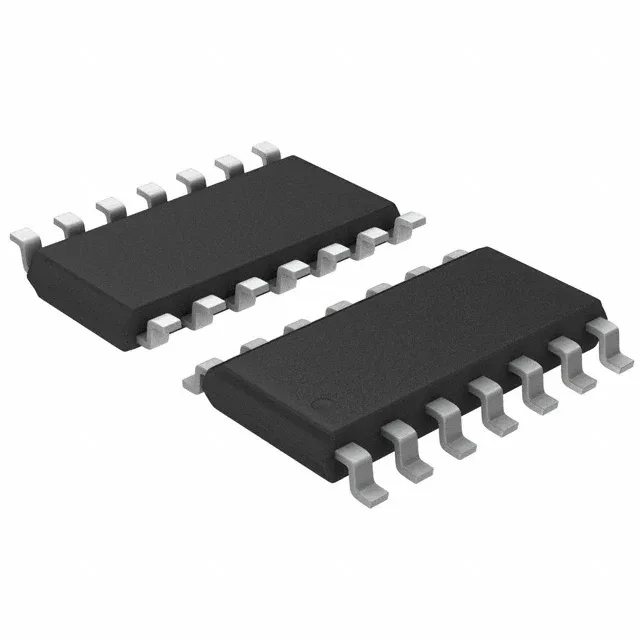
Housed in a 14-SOIC package (0.209", 5.30 mm width) with a 14-SO supplier device code. Surface-mount only. The 14-SOIC footprint is standard and shared with many quad op amps, including the LM324 family in SOIC-14 — a common cross-shop candidate. No thermal pad; junction-to-ambient thermal resistance will be typical for this package size. Plan for standard decoupling: a 0.1 µF ceramic near each supply pin.