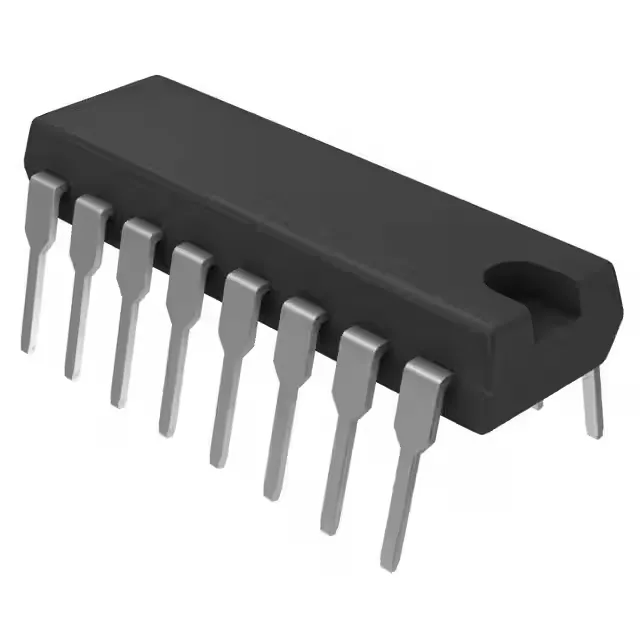
Texas Instruments MAX232INE4 — Interface & Transceivers

MAX232INE4 RS-232 Transceiver, 120 kbps, 2/2 Driver/Receiver

MPNMAX232INE4
End of Life

Texas Instruments MAX232INE4 RS-232 transceiver, full duplex, 120 Kbps data rate, 2/2 drivers/receivers, 4.5V~5.5V supply, -40°C~85°C, 16-DIP package.

Independent supplier — new & surplus stockAuthenticity-screened · ESD-safe packingListing updated Aug 2026

Specifications

MAX232INE4 specifications
ParameterValue
TypeTransceiver
MountingThrough Hole
Supply voltage4.5V ~ 5.5V
ProtocolRS232
Operating temperature-40°C~85°C
DuplexFull
PackageTube
Data rate120Kbps
Case16-DIP (0.300\", 7.62mm)
Receiver hysteresis500 mV
Number of drivers (Receivers)2/2

Product details

Why the 5 V supply still matters for RS-232

The 5 V-only supply is a design constraint — this part does not generate the ±10 V RS-232 levels from a lower rail — it needs the external charge-pump capacitors (four 1 µF electrolytics, follow the datasheet layout) to produce the swing. The through-hole DIP package suits socketed prototypes, test fixtures, or legacy equipment where surface-mount retrofits are avoided.

There is no EOL notice, no last-time-buy deadline. The standard lead time runs through TI's distribution channel; independent distributors also carry inventory for spot needs.

At 120 kbps, the MAX232INE4 supports common baud rates up to 115200 with margin. The 500 mV receiver hysteresis ensures a clean logic output even when the cable picks up noise. For designs that need higher throughput — say 250 kbps or 1 Mbps — this part is not the fit; look at the MAX3232 or MAX3222 family for faster slew-rate-limited RS-232 transceivers. The full-duplex capability means simultaneous transmit and receive on each of the two channels, which maps to two independent UART ports.

Frequently asked questions

Does MAX232INE4 require external capacitors?

Yes — the MAX232INE4 uses the standard MAX232 charge-pump topology and requires four external 1 µF capacitors (typically electrolytic or ceramic) to generate the ±10 V RS-232 output levels. Follow the datasheet pin connections: C1+, C1-, C2+, C2-, V+, V-.

What is the difference between MAX232INE4 and MAX232E?

The MAX232E suffix typically denotes an enhanced ESD rating (±15 kV HBM) compared to the standard MAX232. Both share the same 2/2 driver/receiver count, 120 kbps data rate, and 5 V supply. The key difference is package and temperature grade — the MAX232INE4 is specifically the DIP-16 industrial-temp version.

Is MAX232INE4 compatible with MAX232CPE?

Yes — the MAX232CPE is a pin-compatible DIP-16 RS-232 transceiver from the same MAX232 family. Both are 5 V, 2/2 driver/receiver, 120 kbps parts. For extended-temperature designs, the INE4 is the correct choice.