18 µV V_os — the precision baseline
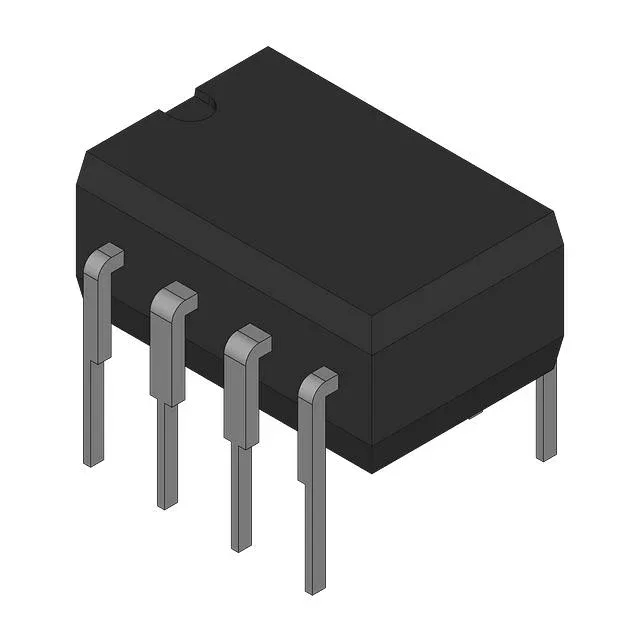
The Linear Technology LT1001CP is a single-channel, general-purpose precision operational amplifier in an 8-DIP through-hole package. Its defining characteristic is an 18 µV typical input offset voltage — a figure that puts it squarely in the precision class, suitable for low-drift signal conditioning, thermocouple amplification, and bridge-sensor front ends where DC accuracy matters more than speed. The 800 kHz gain-bandwidth product and 0.25 V/µs slew rate confirm this is a DC-precise, not a fast-settling, device. Supply span from 8 V to 44 V covers single-rail 12 V/24 V industrial buses and dual ±15 V rails; the 700 pA input bias current keeps loading on high-impedance sources manageable.
800 kHz GBP and 0.25 V/µs slew — where the speed runs out
At 800 kHz GBP this part handles audio-band filtering and low-frequency servo loops, but the 0.25 V/µs slew rate means large-signal steps (e.g., a 10 V p-p output swing) take about 40 µs to settle. That rules out fast comparator, ADC driver, or video applications. For a direct parametric contrast: the surface-mount TLV9351IDCKR from TI offers 3.5 MHz GBP and 20 V/µs slew rate with rail-to-rail output, but at a 350 µV typical offset — a trade-off of speed for the LT1001CP's 20× better DC precision. The LT1001CP is the part you pick when the error budget is in microvolts, not when the signal runs fast.
8-DIP through-hole — legacy footprint, no reflow
The 8-DIP (0.300" row spacing) through-hole package is the board-fit constraint. No SMT reflow — hand-solder, wave-solder, or socket. The RoHS non-compliant status means this part carries lead-bearing solder finish; it cannot be used in EU RoHS-compliant production without an exemption, but it remains common in legacy repair, military/aerospace exempt builds, and hobbyist or prototyping work where leaded solder is acceptable.
Active product — no end-of-life pressure
The RoHS non-compliance is the only sourcing friction — verify your jurisdiction's exemption rules before committing the BOM line.