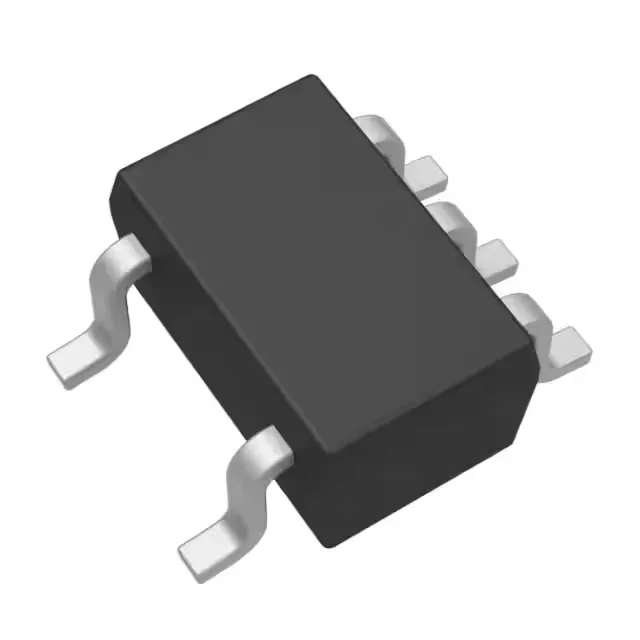
Ultra-low-power op-amp for battery-duty signal chains
The LPV511MGX/NOPB is a single-channel general-purpose operational amplifier from Texas Instruments, packaged in a 5-lead SC-70-5 (SOT-353) footprint. Its 25 kHz gain-bandwidth product and 0.0077 V/µs slew rate place it firmly in the micropower class — the bandwidth is intentionally narrow to keep the supply current at 1.2 µA. Rail-to-rail output swing means the signal can reach within millivolts of the supply rails, preserving dynamic range in low-voltage systems operating from 2.7 V to 12 V. Input bias current is 320 pA typical, and input offset voltage is 200 µV — adequate for conditioning sensor outputs where the signal floor is above the microvolt range.
What the 25 kHz GBW and 1.2 µA supply mean for the BOM
A 25 kHz gain-bandwidth product limits the usable closed-loop gain at higher frequencies — at a gain of 10, the -3 dB bandwidth is roughly 2.5 kHz. This is intentional: the 1.2 µA quiescent current is the trade-off. The part is designed for always-on sensor interfaces, battery monitors, and threshold detectors where the signal is DC or low-frequency AC, not for audio or fast servo loops. The 0.0077 V/µs slew rate means the output takes about 130 µs to swing 1 V. For a 1 kHz sine wave at 1 V amplitude, the required slew rate is about 0.0063 V/µs — this part just meets it with margin. Higher-frequency or larger-swing signals will distort. The output can source or sink 1.3 mA, enough to drive a microcontroller ADC input or a reference buffer, but not a heavy load like a relay coil.
Active lifecycle and supply posture
Texas Instruments lists the LPV511MGX/NOPB as Active with RoHS3 compliance. The part is sourced through authorized and independent distribution; current pricing and lead time are confirmed at RFQ against the BOM quantity. The SC-70-5 package is a standard small-outline footprint shared by many TI op-amps. The Tape & Reel option (Cut Tape also available) suits both prototyping and production reels. Store the reels dry — the MSL is typically Level 1 for this package, but verify the date-code-specific moisture sensitivity label on the reel.
Industrial temperature range and deployment
Rated for -40°C to +85°C operating temperature, the LPV511MGX/NOPB covers the industrial ambient range. It fits in outdoor telecom equipment, battery-powered field instruments, and automotive cabin applications where the ambient stays below 85°C. The 2.7 V minimum supply lets it run directly from two alkaline cells or a Li-ion battery near end-of-discharge.