Automotive PMIC with dual buck converters and dual LDOs
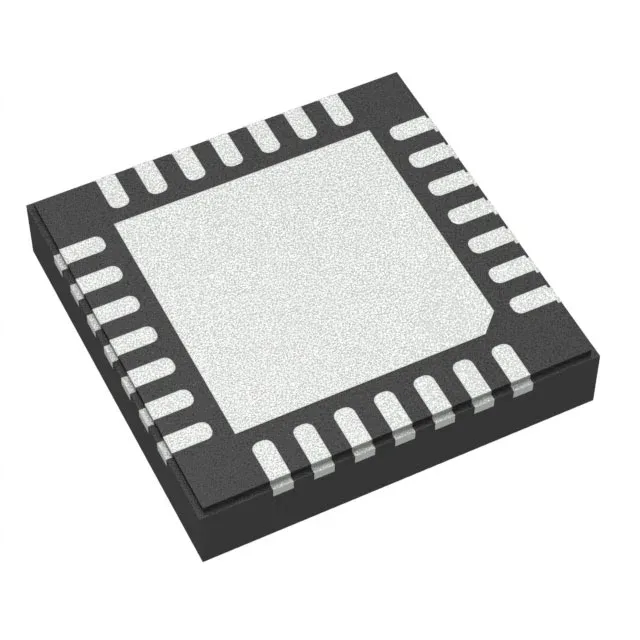
The LP873245RHDRQ1 is an automotive-grade power management IC from Texas Instruments, rated AEC-Q100 for -40 to +125°C ambient operation. It integrates two 2 A step-down (buck) converters and two 300 mA low-dropout (LDO) linear regulators in a single 28-VQFN package with wettable flank terminals.
Output rails and sequencing for SoC power trees
Each of the two buck converters delivers up to 2 A with a programmable output from 0.7 V to 3.36 V — sized for the core and memory rails of an automotive SoC or FPGA. The two LDOs each source 300 mA from 0.8 V to 3.3 V, typically used for PLL, analog, or I/O supplies that need lower noise than a switching regulator provides. The 2 MHz switching frequency on the buck converters places the fundamental and its harmonics above the AM radio band, reducing in-cabin interference risk. It also shrinks the output inductor to the 1-2.2 µH range, keeping the total solution footprint under 50 mm² in a typical layout. An integrated power sequencer manages the turn-on order of the four rails without an external supervisor or GPIO from the host processor — the start-up timing is programmable via the I²C-compatible interface, so the core rail can be guaranteed stable before the I/O and analog rails ramp.
Package, thermal, and inspection considerations
The 28-VQFN package (5x5 mm) with an exposed thermal pad requires a thermal via array under the pad to the ground plane — the datasheet recommends a 2x2 array of 0.3 mm vias to keep the junction temperature below 125°C at full load in a 85°C ambient environment. Wettable flank terminals on the QFN package enable automatic optical inspection (AOI) of the solder fillet after reflow — critical for automotive production lines that require side-wetting verification per IPC-A-610 Class 3. No X-ray is needed to confirm the hidden pad connections.