150 mA fixed 3 V LDO with 55 µA Iq
The LP5951MF-3.0/NOPB: The 0.35 V maximum dropout at full load means the input supply must stay above 3.35 V across the load range to keep the output in regulation — a 3.6 V lithium cell near end-of-discharge still has margin, but a 3.3 V rail does not. Quiescent current is 55 µA typical, rising to 70 µA maximum under full supply. For a battery-powered device that spends most of its life in standby with the LDO enabled, that 55 µA draw is the floor of the always-on budget — below most discrete shunt regulators but above an ultra-low-Iq part like the TPS7A02. The Enable pin lets an external controller gate the output entirely, pulling the supply current to near zero when the rail is unused.
PSRR across the audio and switching band
Power-supply rejection ratio is specified at 60 dB at 100 Hz, rolling to 50 dB at 10 kHz. This covers the ripple frequencies from mains rectification (100/120 Hz) through the fundamental of most switching regulators (hundreds of kHz to low MHz). The 10 kHz point is where many LDOs start to lose rejection — the LP5951 holds 50 dB, which attenuates a 10 mV ripple on the input to roughly 32 µV on the output. For an analog front-end or audio codec powered from a noisy 5 V bus, that rejection keeps supply-induced artifacts below the noise floor of a 16-bit converter.
Industrial temperature range and protection
The built-in over-current, over-temperature, and short-circuit protection means the regulator can survive a sustained output short without external foldback circuitry — the thermal shutdown cycles the output until the fault clears.
SOT-23-5 board-fit and sourcing
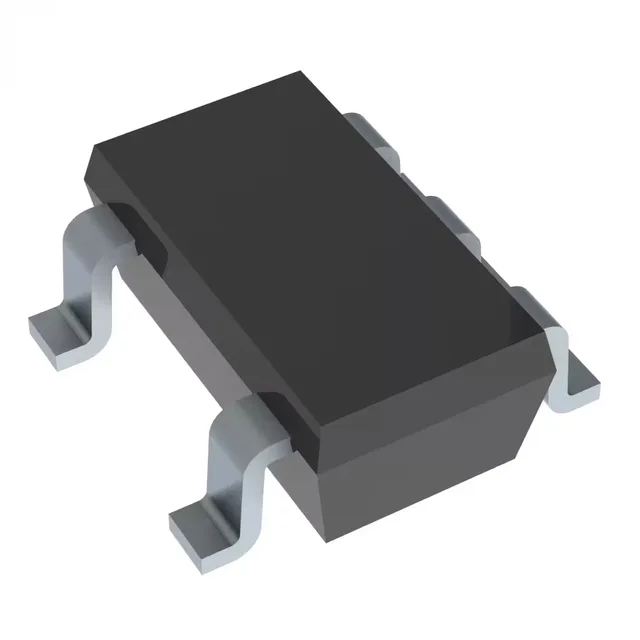
The part comes in a 5-lead SOT-23 (SC-74A) package — standard 0.95 mm pin pitch, 2.9 mm body length. No exposed thermal pad; heat dissipates through the leads and the copper traces on the PCB. For 150 mA at 3 V output from a 5 V input, the power dissipation is 0.3 W — in still air at 25°C the junction stays well below the 125°C limit with minimal copper area, but at 125°C ambient the same dissipation pushes the junction toward the ceiling. Keep the input-to-output differential as low as the dropout allows.