PSRR across frequency — what 90 dB to 60 dB means for the rail
The LP5907SNX-2.5/NOPB: PSRR is specified at 90 dB at 100 Hz, rolling off to 60 dB at 100 kHz — this is the regulator's ability to reject input ripple and noise from the upstream supply before it reaches the load. For a 2.5V rail powering a sensitive analog front-end or RF PLL, the 90 dB rejection at 100 Hz attenuates 10 mV of 100 Hz ripple to 0.3 µV at the output; the 60 dB floor at 100 kHz still knocks down switching converter noise by a factor of 1000. The 25 µA quiescent current means this LDO can be left powered in always-on sensor or wireless nodes without draining the battery during sleep — the regulator's own draw is comparable to the MCU's deep-sleep current.
250 mA fixed 2.5V — which loads it serves
Fixed 2.5V output at 250 mA continuous — this is a core rail for low-voltage digital logic (1.8V to 3.3V translation), MCU analog supplies, or sensor bias where the load stays under a quarter amp.
4-X2SON 1x1 mm — board-fit for space-constrained layouts
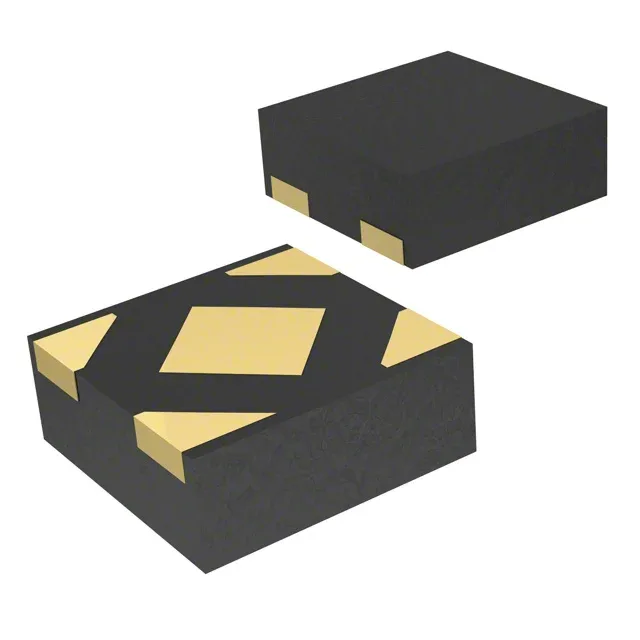
Housed in a 4-X2SON package measuring 1.0 mm × 1.0 mm (supplier device package 4-X2SON), the LP5907SNX-2.5/NOPB fits into compact IoT modules, wearable PCBs, and multi-layer smartphone-style boards where every mm² counts. The exposed pad on the 4-XDFN package provides a thermal path to the PCB copper — for 250 mA at 1V dropout (250 mW dissipation), the junction-to-board thermal resistance keeps the die well within the 125°C limit when the pad is soldered to a ground plane. Enable pin allows the regulator to be shut down externally, dropping the supply current to near zero — useful for sequenced power-up or low-power standby modes in battery-operated designs.
Compliance and protection features
ROHS3 compliant — the NOPB suffix indicates lead-free (Pb-free) and RoHS-compliant finish, meeting EU Directive 2011/65/EU requirements for global BOMs. Built-in over-temperature and short-circuit protection prevent damage from output faults or excessive load — the regulator enters thermal shutdown and auto-recovers when the junction cools.