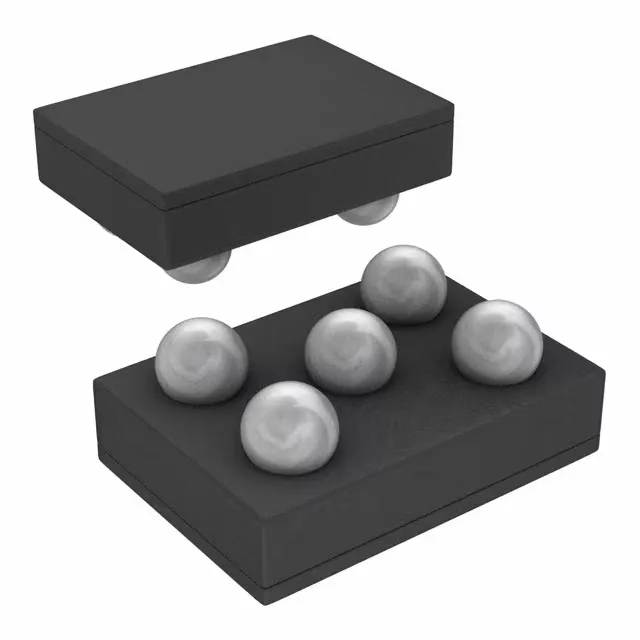
The LP3995ITL-2.5/NOPB: The part is RoHS3 compliant, which means it meets the current EU restriction without exemptions — no lead, no phthalates, no red-phosphorus risk in the molding compound.
Key parametrics for the power rail
Fixed 2.5 V output at 150 mA continuous — the dropout voltage is only 0.1 V max at full load, so a 2.7 V input rail leaves enough headroom to keep the output in regulation even under load transients. PSRR runs 60 dB at 1 kHz, rolling off to 50 dB at 10 kHz — that 10 dB drop across a decade is typical for a low-Iq LDO; upstream switching noise at 1 MHz will see far less rejection, so a pi-filter ahead of the input is worth considering if the supply is a buck converter. Quiescent current is 150 µA typical, with a maximum supply current of 200 µA — the 50 µA margin between typical and max is the internal bias shift over temperature; budget the max figure for worst-case thermal analysis.
That footprint is about the size of a grain of rice; the 0.5 mm pitch BGA demands a solder-mask-defined pad with a 0.25 mm aperture and a stencil thickness of 100–125 µm for a reliable joint. Cut Tape works for prototype runs or small-batch builds. Control features include an Enable pin — pulling it low shuts down the output and drops the quiescent current to near zero; useful for sequencing multiple rails or saving power in sleep modes.
Protection and compliance
Built-in protection covers over-temperature and short-circuit — the thermal shutdown threshold is typically 160°C junction; the short-circuit current foldback limits the output to about 300 mA until the fault clears. The output configuration is positive with a single regulator — it is a standard N-channel pass-FET LDO, so the dropout is low but the output capacitor ESR matters for stability; TI recommends a 1 µF ceramic on the output. Maximum input voltage is 6 V — the absolute maximum is 7 V, but staying below 6 V keeps the internal pass transistor in its safe operating area across the full temperature range.