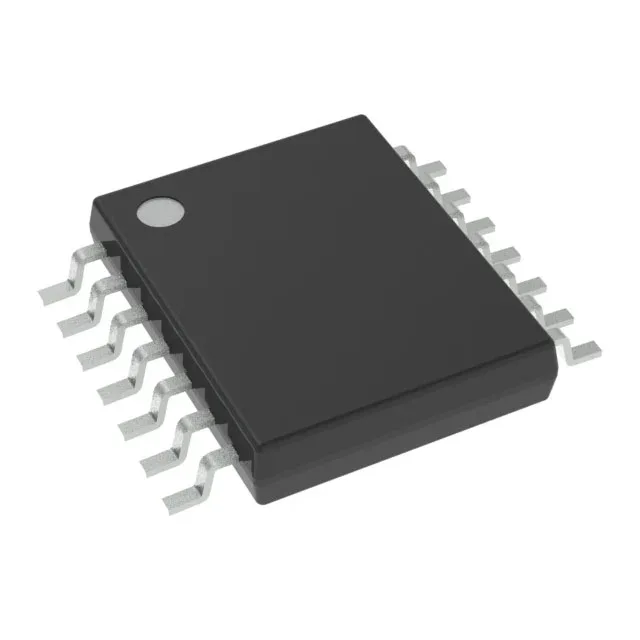
Micropower quad op-amp for low-frequency signal chains
The 100 kHz gain-bandwidth product and 0.05 V/µs slew rate define its territory: DC and low-frequency signal conditioning — thermocouple amplifiers, strain-gauge bridges, battery voltage monitoring, and similar sub-audio analog processing. The supply span from 3 V to 32 V covers single 5 V logic rails, 12 V industrial buses, and 24 V battery systems without needing a secondary regulator.
With a slew rate of 0.05 V/µs and gain-bandwidth product of 100 kHz, this part is squarely in the micropower, low-frequency class. For a 1 V peak output swing, the maximum undistorted frequency is roughly 8 kHz — fine for DC sensor outputs or low-speed telemetry, but not for audio line-level signals or switching amplifier loops. The 2 mV input offset voltage and 2 nA input bias current are adequate for general-purpose conditioning of millivolt-level signals from resistive bridges or thermocouples, though a precision amplifier would be needed for microvolt-level measurements.
The 3 V minimum supply lets this quad op-amp run directly from a single lithium cell or a 3.3 V regulated rail, while the 32 V maximum allows operation on 24 V industrial supplies with headroom.
It is ROHS3 compliant. There is no official TI successor listed for this exact order code, but the LP324 family is broadly second-sourced by multiple manufacturers — the standard LM324 pinout is compatible, though the LP324's micropower supply current (85 µA versus roughly 500 µA for the LM324) is the key differentiator.