150 mA, 1.8 V fixed output — the load and rail it serves
The LP2985IM5-1.8/NOPB: That 150 mA ceiling suits it for powering low-current digital cores, sensor front-ends, or wireless transceiver rails where the downstream draw stays under the limit — think a 100 mA MCU plus a few milliamps of peripheral load. Maximum dropout is 0.58 V at full load, meaning the input rail must stay above roughly 2.38 V to maintain regulation. A 3.3 V supply with 10% tolerance dips to 2.97 V — still 0.59 V headroom, just enough. If the input is a Li-ion cell (3.0 V cutoff), the regulator drops out before the cell is fully drained, so a boost or higher-voltage rail upstream is needed.
Quiescent current and PSRR — the battery-life and noise trade-off
Quiescent current is 95 µA typical — not the lowest in the LDO class, but reasonable for always-on blocks in a battery-powered design. PSRR is 45 dB at 1 kHz. That knocks down 100 mV of 1 kHz ripple to about 560 µV at the output — adequate for a digital rail but marginal for a sensitive analog front-end. If the load is an audio codec or precision ADC, the 45 dB figure means the upstream switcher's ripple needs to be low to start with, or a second-stage filter is warranted.
Temperature grade and protection — where this LDO survives
The 125°C ceiling includes self-heating: at 150 mA with 0.58 V dropout, dissipation is 87 mW — in the SOT-23-5 package that translates to roughly 30-40°C rise above ambient, so a 105°C ambient still keeps the junction under the limit. Built-in over-current, over-temperature, and short-circuit protection mean the regulator folds back or shuts down before damaging itself or the load. These are current-limit and thermal-shutdown circuits, not precision current sources — they prevent catastrophic failure, not regulate fault current.
Package and board-fit — SOT-23-5 footprint
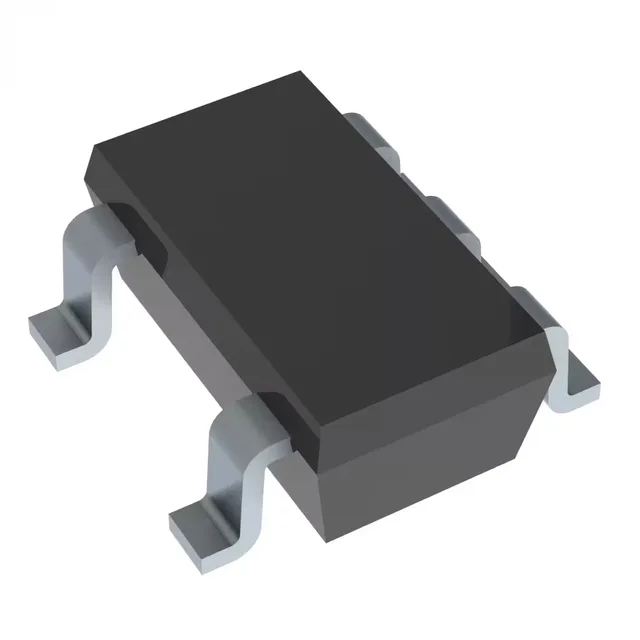
Housed in a 5-pin SOT-23 (SC-74A), the same footprint as countless other small LDOs and logic devices. The 0.95 mm pitch and 2.9 x 1.6 mm body fit tight layouts without requiring a 4-layer board for fan-out. The supplier device package is SOT-23-5 — the standard land pattern applies. Available in Tape & Reel for production pick-and-place or Cut Tape for prototyping. The ROHS3 compliance covers the full bill of materials — no exemptions that complicate end-product certification.