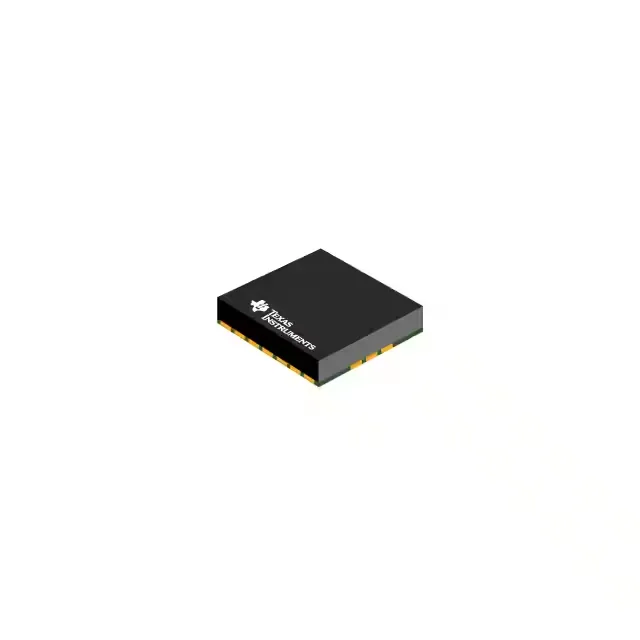
PLL with bypass and dual-frequency ceiling
The LMX2434SLEX/NOPB is a PLLatinum™ frequency synthesizer from Texas Instruments that integrates a phase-locked loop with a bypass mode — the PLL can be bypassed to feed an external modulation signal directly to the VCO, useful for test modes or direct FSK modulation without loop-filter interaction. Its dual-frequency maximums — 5 GHz on the RF path and 2.5 GHz on the IF path — set the upper band for down-conversion in superheterodyne receivers or direct-RF synthesis in wireless infrastructure and test equipment.
Surface-mount assembly with a 0.50 mm pitch; the narrow pad spacing requires a solder-mask-defined land pattern per the TI application note for QFN packages.
Supply and signal interface
The RF input is differential (Yes/No input:output), so the driving source — typically a VCO buffer or balun — must provide a differential signal; the CMOS output is single-ended and drives the downstream logic or divider chain. Three reference inputs feed two synthesizer paths (3:2 ratio), allowing independent LO generation for the RF and IF stages from a shared reference oscillator.
Lifecycle status is Active per Texas Instruments, so the part remains a current-design choice with no NRND or EOL flags — no last-time-buy pressure for new BOMs.