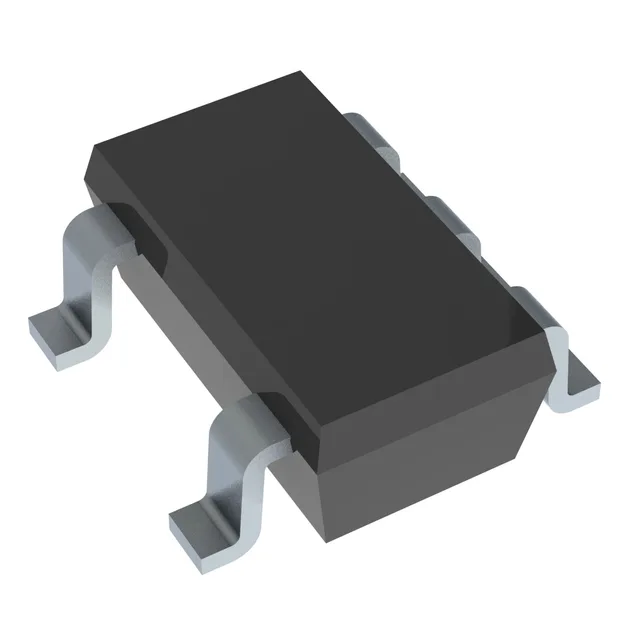
What the AEC-Q100 grade means for your BOM
The LMV931Q1MF/NOPB: This is an automotive-grade part — AEC-Q100 qualified — which means it passed the stress tests (temperature cycling, ESD, latch-up) that the commercial-grade LMV931MF did not. The die and package are the same; the suffix Q1 buys you the qualification paperwork and the -40°C to 125°C operating range that a Tier-1 ECU requires. If your BOM currently calls out the commercial version, this drops in without a board spin — same SOT-23-5 footprint, same 1.8 V to 5.5 V supply span, same 1.5 MHz gain-bandwidth.
Bandwidth and slew rate — where the ceiling sits
The 1.5 MHz gain-bandwidth product sets the usable closed-loop gain before the open-loop gain rolls off. At a gain of 10, the -3 dB bandwidth is roughly 150 kHz — fine for filtering a 10 kHz PWM ripple or conditioning a slow-changing thermistor voltage. The 0.42 V/µs slew rate means a full 5 V output swing slews in about 12 µs; if you need to drive a 10 kHz sine wave at full amplitude, the slew rate limits the undistorted output to about 670 mV peak at that frequency.
Supply current and input bias — the always-on trade
At 116 µA supply current, this op-amp is not in the ultra-low-power class (you can find 1 µA parts for battery-monitoring), but it is low enough for an always-sensing automotive module that draws a few milliamps total. The 14 nA input bias current is bipolar — not FET — so if your source impedance is above 100 kΩ, the bias current times the source resistance starts to look like an offset voltage that adds to the 1 mV input offset. For a 10 kΩ sensor, the 14 nA bias adds 140 µV of offset — negligible against the 1 mV spec.