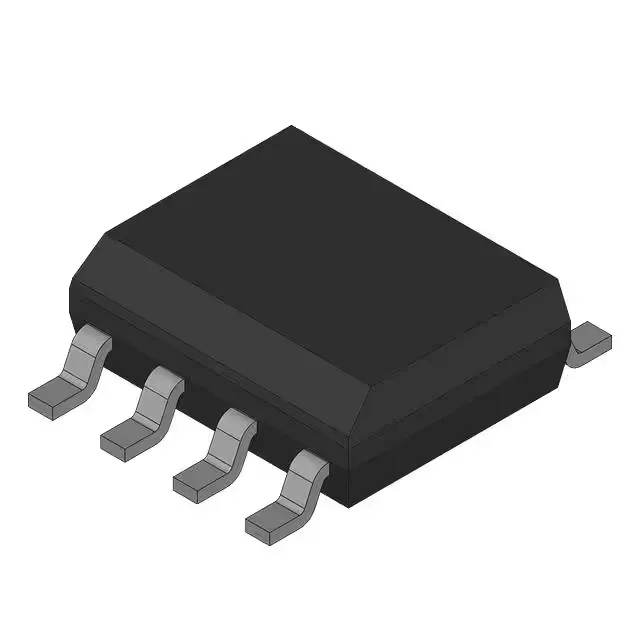
Dual op-amp for signal conditioning — 5.6 MHz GBW, AEC-Q100
The rail-to-rail output stage preserves dynamic range in low-voltage single-supply designs — useful for sensor signal conditioning, ADC drivers, or active filters in automotive and industrial control systems.
At 500 µA per channel, the LMV822MX sits in a power-efficient tier. For higher speed or lower bias current, the TLV9362IDDFR (10.6 MHz, 25 V/µs, 10 pA input bias) is a faster, lower-bias alternative in the same dual-channel footprint.
Temperature grade and automotive qualification
For under-hood or 125°C ambient, look at the TLV9351IDCKR (3.5 MHz, 20 V/µs, 10 pA input bias, -40°C to 125°C) or the TLV9362IDDFR, both rated to 125°C.
The standard SOIC-8 footprint is shared across many dual op-amps, making this a drop-in candidate for existing layouts.
Note that this variant is RoHS non-compliant, which may affect its eligibility for certain regions or lead-free assembly lines.