What the 3.5 MHz GBW and 1.4 V/µs slew rate mean for your signal chain
The LMV774MTX/NOPB is a quad general-purpose op-amp from the LMV® series, offering a gain-bandwidth product of 3.5 MHz and a slew rate of 1.4 V/µs. This combination supports signal frequencies up to roughly 350 kHz at unity gain before the open-loop gain drops by 3 dB, making it suitable for sensor conditioning, active filters, and low-speed data acquisition where the signal bandwidth stays under a few hundred kilohertz. The 1.4 V/µs slew rate means a full-scale 5 V output step settles in about 3.6 µs — fast enough for most industrial analog loops but not for video or high-speed ADC drivers. If your application needs to track fast transients above 100 kHz, a part with a higher slew rate (like the TLV9351IDCKR at 20 V/µs) would be a better fit.
Low-power quad channel for multi-sensor boards
Each of the four amplifiers draws 600 µA total supply current, or about 150 µA per channel. That is low enough to keep the thermal rise minimal in the 14-TSSOP package and makes the part a candidate for battery-powered or multi-channel data-acquisition modules where every milliamp counts. The input bias current is 0.23 pA typical, which is essential when the source impedance is high — think pH probes, photodiode front-ends, or high-value resistor dividers. A bias current in the picoamp range means the voltage error across a 10 MΩ source is only 2.3 µV, negligible for most 12-bit systems. Input offset voltage is 250 µV maximum, which sets the DC accuracy floor. For a gain of 100, that offset appears as 25 mV at the output — acceptable for many industrial control loops but worth derating if your system targets better than 0.1% full-scale accuracy without auto-zeroing.
Package and rework: 14-TSSOP on the bench
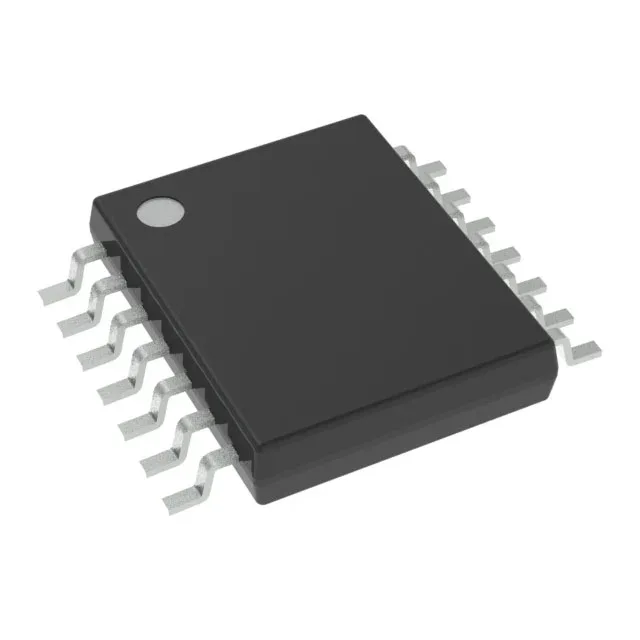
The 14-TSSOP package (4.40 mm body width, 0.65 mm pitch) is a standard fine-pitch SOIC variant. It reflows well with a standard hot-air profile — 200°C preheat, 260°C peak for 10 seconds — and the 0.65 mm pitch means you can hand-solder it with a fine tip and magnification if you are careful. No hidden thermal pad, so the risk of tombstoning is low. Pin 1 is marked by a dot on the top of the package and a chamfer on the left edge. The orientation is unambiguous under a microscope, which saves time when you are reworking a board that already has passives around the op-amp.
Temperature range and compliance
Rated for -40°C to 125°C operating temperature, the LMV774MTX/NOPB covers the full industrial temperature span. That includes engine-bay electronics, outdoor telecom cabinets, and factory-floor sensor modules that see thermal cycling. Texas Instruments lists this part as Active in production, with ROHS3 compliance. The part is supplied in Tape & Reel or Cut Tape options.