It delivers a 10 MHz gain-bandwidth product and a 5.25 V/µs slew rate, making it a solid choice for signal conditioning, active filters, sensor buffering, and audio paths in systems that run from a 2.2 V to 5 V supply.
A 10 MHz gain-bandwidth product means this op-amp can provide a closed-loop gain of 10 up to about 1 MHz, or unity-gain bandwidth up to 10 MHz — sufficient for audio-frequency processing, anti-aliasing filters, and moderate-speed sensor interfaces. If your application needs faster edges or higher-frequency large-signal swings, a part like the TLV9351IDCKR (20 V/µs slew) would be a better fit, though at a lower 3.5 MHz GBW.
Supply range and rail-to-rail output
Rail-to-rail output means the output can swing to within a few millivolts of both supply rails, preserving dynamic range in low-voltage systems — important when the ADC reference is the same supply.
Input offset and bias current — DC precision
With a typical input offset voltage of 80 µV and input bias current of 260 nA, this op-amp offers reasonable DC precision for general-purpose use. The 80 µV offset is low enough that many sensor and measurement circuits can avoid a calibration step, though the 260 nA bias current is higher than CMOS-input op-amps (which are typically picoamps) — so if your source impedance is above a few tens of kilo-ohms, a CMOS-input alternative like the TLV9351IDCKR (10 pA bias) would introduce less DC error.
Package and footprint — SOT-23-5
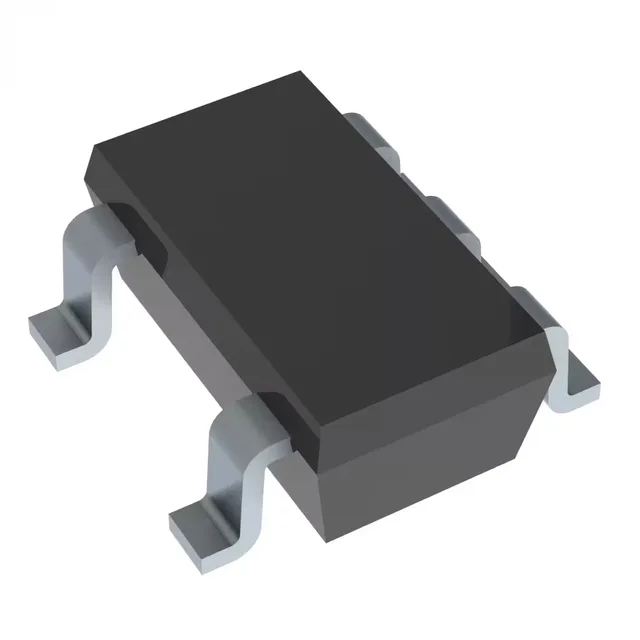
The LMV721IDBVR comes in a SOT-23-5 package (also designated SC-74A, SOT-753), a common 5-pin footprint for single op-amps. The small body saves board space, and the pinout is shared by many other SOT-23-5 op-amps, making it straightforward to qualify an alternate if supply tightens. Surface-mount assembly is standard; no special thermal management is needed at the 1.03 mA quiescent current.
If you need a second-source option for dual-sourcing resilience, the TLV9351IDCKR (also SOT-23-5, rail-to-rail output, 3.5 MHz GBW, 20 V/µs slew) is a functional alternative with lower bias current, though its gain-bandwidth is lower.