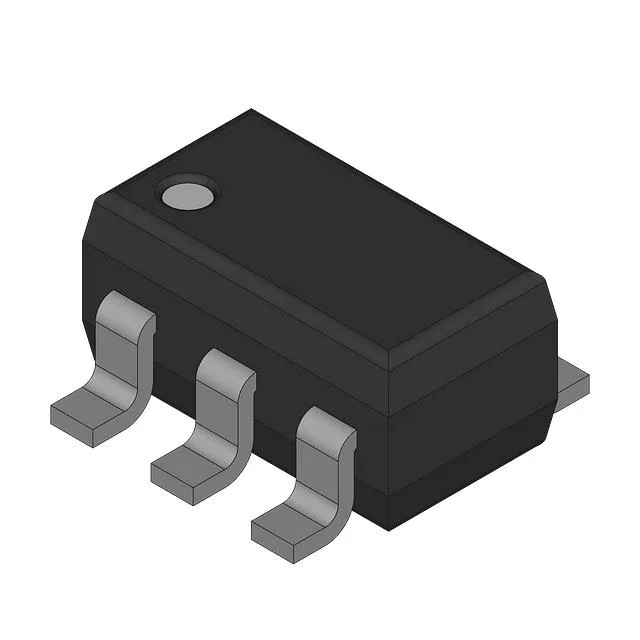
SOT-23-5 footprint and board integration
The LMV331M5X-TI comes in a SOT-23-5 (SC-74A) surface-mount package, occupying about 3 mm × 3 mm of board area. The 0.95 mm pin pitch is manageable with a standard two-layer PCB, but the small pad geometry means the solder paste stencil aperture and reflow profile need to be dialled in for consistent wetting — especially on the centre pad, which is the thermal path to the board.
Propagation delay and output drive
600 ns typical propagation delay sets the bandwidth ceiling for threshold detection — it will catch a 1 µs pulse but not a 100 ns glitch. The output stage sinks or sources 84 mA at 5 V, enough to drive an LED indicator, a small relay coil, or a logic input directly without a buffer transistor.
Input characteristics and precision
Input bias current maxes at 0.25 µA at 5 V, so a high-impedance sensor like a photodiode or thermistor sees negligible loading — the voltage drop across a 10 kΩ source resistor is only 2.5 mV. The 7 mV input offset voltage is fine for over/under-voltage detection or zero-crossing, but a precision measurement loop (e.g., 0.1 % accuracy) will need a lower-offset comparator like the TLV3501 series.
RoHS compliance flag
This part is marked RoHS non-compliant. If your BOM falls under EU RoHS, China RoHS, or similar regulations, you will need an exemption or a waiver — or switch to the RoHS-compliant variant (LMV331M5/NOPB). For non-regulated markets or legacy designs with a leaded-solder process, the non-compliant version is fine.