5A fixed 3.3V rail — the headline rating and the dropout headroom
The LMS1585ACSX-3.3/NOPB: This is a single-output positive LDO delivering a fixed 3.3V at up to 5A continuous — enough to power a small FPGA core rail, a bank of DDR termination, or a post-switcher analog supply that needs clean voltage. A 5V rail with 5% tolerance (4.75V min) just barely clears it; a 5V rail that dips to 4.5V under transient will push the output out of spec. Input voltage maxes at 13V, so the part also works cleanly off a 12V intermediate bus — just watch the dropout headroom if the bus sags under load.
72 dB PSRR — why that number matters on a noise-sensitive rail
The 72 dB power-supply rejection ratio at 120 Hz tells you how well this regulator attenuates ripple from a full-wave rectified input or a switching pre-regulator. 72 dB is a factor of roughly 4000:1 — a 100 mVpp ripple on the input becomes about 25 µVpp on the output at that frequency. For an analog front-end or a precision ADC reference, that keeps the noise floor low enough that the regulator itself is not the limiting element.
Package — DDPAK/TO-263-3 and board integration
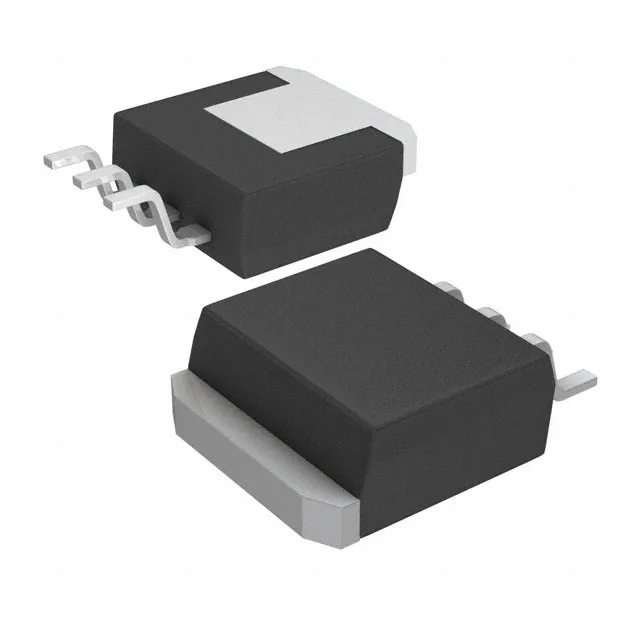
The DDPAK/TO-263-3 (also called D²Pak, 3 leads plus tab) is a surface-mount power package. Without adequate copper area, the junction temperature climbs past the 125°C absolute maximum under sustained load. The part is also available in cut tape or tape-and-reel for production pick-and-place.
Protection and operating range
Built-in over-current and over-temperature protection means the regulator survives a shorted output or a thermal runaway event without latching up or failing open — it folds back current and shuts down until the die cools. The operating temperature range is 0°C to 125°C, which covers commercial and most industrial environments but not automotive under-hood or extended cold-soak below freezing. Quiescent current is 7 mA typical, with a maximum supply current of 13 mA — moderate for a 5A LDO, but worth noting if the rail is always-on in a battery-powered system where every millamp cuts standby time.