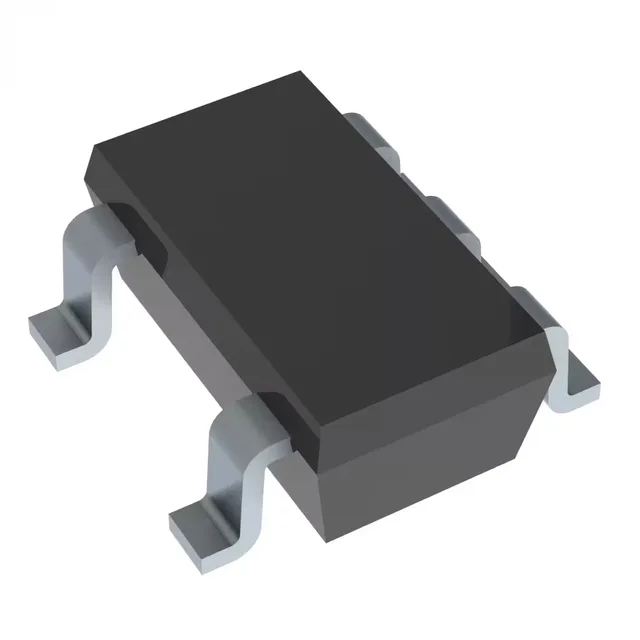
A precision CMOS op-amp that doesn't waste your input signal
The rail-to-rail output stage lets it swing close to the supply rails, which is useful in single-supply systems where every millivolt of headroom counts.
Why the 37 µV offset and 0.2 pA bias matter on your BOM
Input offset voltage is 37 µV typical — that's low enough to avoid a trimming pot in many DC-accurate circuits, saving board space and calibration cost. The 0.2 pA input bias current is the real standout: it lets you interface directly to high-impedance sources like photodiode transimpedance amplifiers or pH probe buffers without the leakage errors that plague bipolar-input op-amps. Supply current is 790 µA per amplifier, which keeps the power budget under control in multi-channel designs.
The supply span runs from 2.7 V up to 12 V, so it works on a single lithium-ion cell or a standard 5 V or 10 V industrial rail.
Package and footprint — SOT-23-5 keeps the board compact
Housed in a SOT-23-5 package (SC-74A), this is a five-pin surface-mount device that fits into tight layouts. No special thermal pad or via array is required at the 790 µA supply level.
Lifecycle — active, no end-of-life concern
It is ROHS3 compliant.