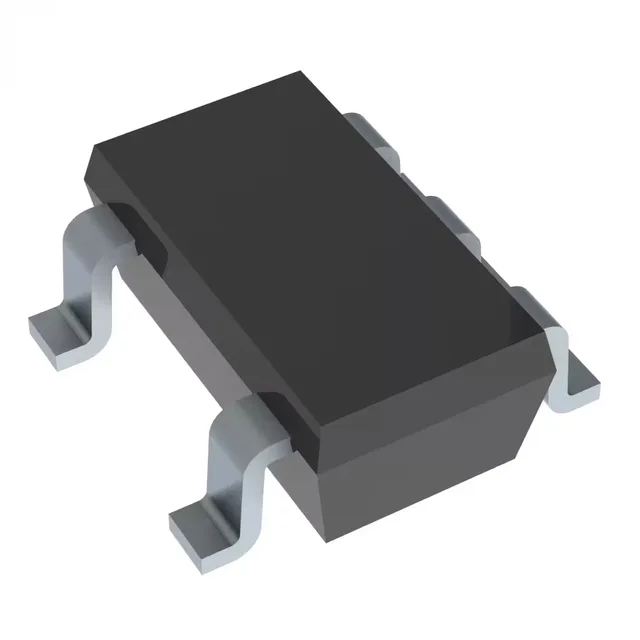
Precision amplifier in a SOT-23-5 — the LMP2011MFX/NOPB
The rail-to-rail output stage lets it swing close to the supply rails in low-voltage single-supply designs, and the 3 MHz gain-bandwidth product covers the DC and low-frequency AC paths these applications typically need.
The 3 pA input bias keeps errors negligible when the source impedance is high, such as a photodiode or a high-value resistor divider. The 3 MHz GBW is modest compared to high-speed amplifiers, but it is more than adequate for the 10 kHz to 100 kHz signal bandwidths common in precision measurement; the slew rate of 4 V/µs supports full-power response up to roughly 100 kHz at 2 Vpp output. The rail-to-rail output is a practical advantage in 3.3 V systems where every millivolt of headroom matters — the output can swing within tens of millivolts of the rails, preserving dynamic range.
The LMP2011MFX/NOPB comes in a 5-pin SOT-23-5 (SC-74A) package. This is a small, surface-mount package with a 0.95 mm pitch — straightforward for reflow assembly, and reworkable with hot air if you keep the temperature under 300°C and watch the adjacent passives.
It is ROHS3 compliant.