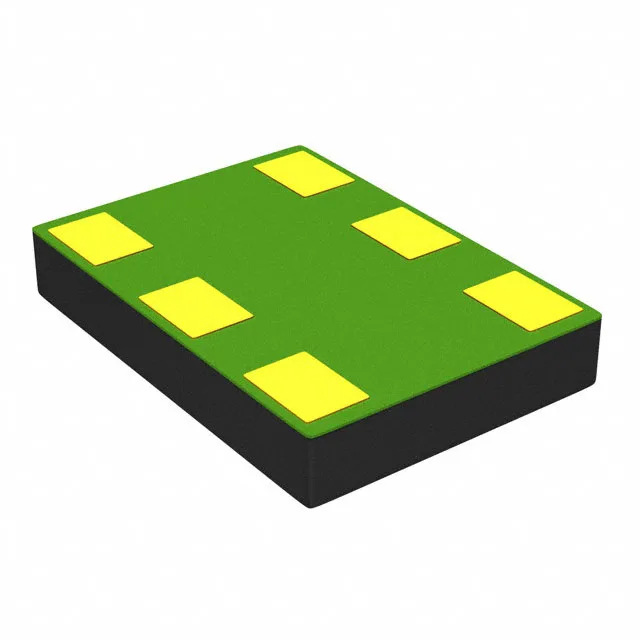
322.265625 MHz output — a non-standard frequency for precision timing
The LMK60I2-322M26SIAT: This is not a standard telecom or Ethernet frequency — it targets applications requiring a precise, non-integer multiple clock for high-speed data converters, FPGA transceivers, or SerDes reference paths where the PLL multiplication ratio lands on an odd numerator. Drawing 90 mA from the supply, the oscillator's power dissipation sits at roughly 300 mW at 3.3 V — a figure that factors into the local thermal budget on a dense board, especially when multiple oscillators share a rail. The 6-QFM (7x5) package, a 7 mm x 5 mm surface-mount module, keeps the footprint compact for tight layout constraints.
For a base station, test equipment, or industrial controller that sees 85°C internal air, the margin is adequate; an engine-bay or under-hood deployment would require a different temperature grade. The supply tolerance of 3.135 V to 3.465 V (±5% around 3.3 V) is tighter than the ±10% common on many logic rails. A regulator feeding this oscillator should hold within that window across load and temperature — a standard 3.3 V LDO with 2% accuracy meets it comfortably.
Active lifecycle and compliance documentation
ROHS3 compliance means it meets the full RoHS exemption regime without restricted substances. The base product number is LMK60I2, indicating this is a specific frequency variant within the LMK60 family. No pin-compatible second source or direct cross-reference from another manufacturer is recorded; the part is single-sourced from Texas Instruments. For BOM risk mitigation, confirm the frequency tolerance and jitter requirements against the datasheet — the oscillator's own phase noise and stability specs govern the link budget in a SerDes application.