Dual wideband op-amp for signal conditioning and ADC drive
It operates from a 5 V to 12 V supply span and draws 9 mA per channel — a power budget that suits it for high-speed signal chains in test equipment, communications receivers, and video distribution amplifiers where wide dynamic range and fast pulse response are required.
For a 5 V peak-to-peak output, the maximum full-power frequency before slew-rate limiting is roughly 17.5 MHz — enough for most video and high-speed ADC driver stages. The 300 MHz -3 dB small-signal bandwidth and 200 MHz gain-bandwidth product mean the part maintains useful gain well into the VHF range, but the designer must account for the 700 nA input bias current and 500 µV input offset voltage when DC accuracy matters. These input specs are typical for a wideband bipolar input stage — not a precision amplifier, but acceptable for AC-coupled or closed-loop gain applications where the offset can be trimmed or nulled.
Supply rails and output drive
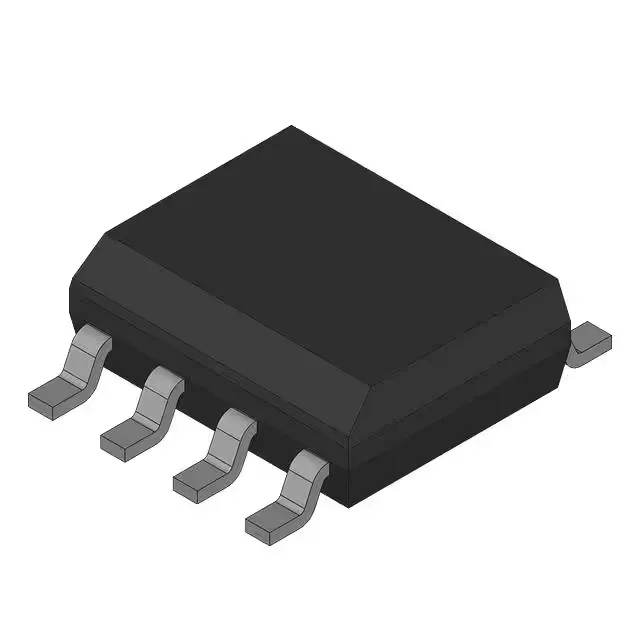
The 5 V to 12 V supply span (minimum to maximum) tells the designer this is a ±5 V or single 5 V to 12 V part — not a 3.3 V or lower-voltage rail device. The 85 mA per channel output current can drive 50 Ω loads or multiple ADC inputs, but the total package dissipation must be checked against the SO-8 thermal impedance at elevated temperatures.
The RoHS compliance is listed as non-compliant, so buyers in RoHS-regulated regions must verify exemption applicability or source the RoHS-compliant variant.