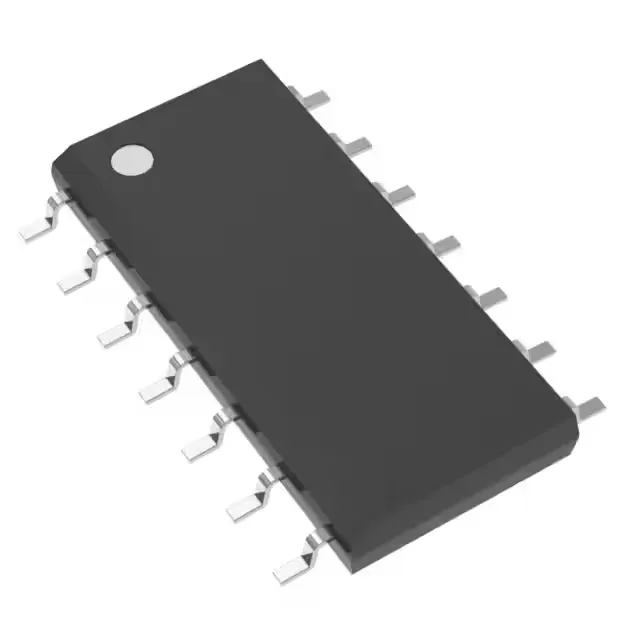
Quad micropower CMOS op-amp for sensor and battery applications
Its total supply current of 90 µA across all four channels makes it a strong candidate for battery-powered sensor interfaces, portable instrumentation, and loop-powered transmitters where every microamp counts. The 0.15 pA input bias current suits high-impedance sources like photodiode detectors or pH probes, while the 250 µV input offset voltage provides enough DC precision for most bridge and thermocouple amplifiers.
The LMC6464AIM/NOPB operates from a single supply spanning 3 V to 15.5 V, so it can run on 3.3 V, 5 V, or 12 V rails without a separate regulator — one line item covers multiple power domains in a mixed-voltage system.
Active lifecycle and ROHS3 compliance — no LTB risk
That means no last-time-buy clock is ticking, and the part is fully Pb-free compatible for current RoHS manufacturing. For a storeroom keeper, this is a part you can stock without worrying about an EOL notice next quarter — it consolidates well into a quad-channel SKU that replaces four single op-amps on the BOM.
A slew rate of 0.028 V/µs limits the maximum output swing at higher frequencies. For a 1 V peak-to-peak signal, the full-power bandwidth is roughly 4.5 kHz — fine for DC-coupled sensor outputs and 50/60 Hz line-frequency filtering, but not for audio above a few hundred hertz or any PWM demodulation. If your design needs to track a fast-changing signal, this is not the part; if you are amplifying a thermocouple or a bridge output, the slow slew rate actually helps filter out high-frequency noise.
Rail-to-rail output and 75 mA drive
Just watch the package thermal limits if you load all four channels near the maximum simultaneously.