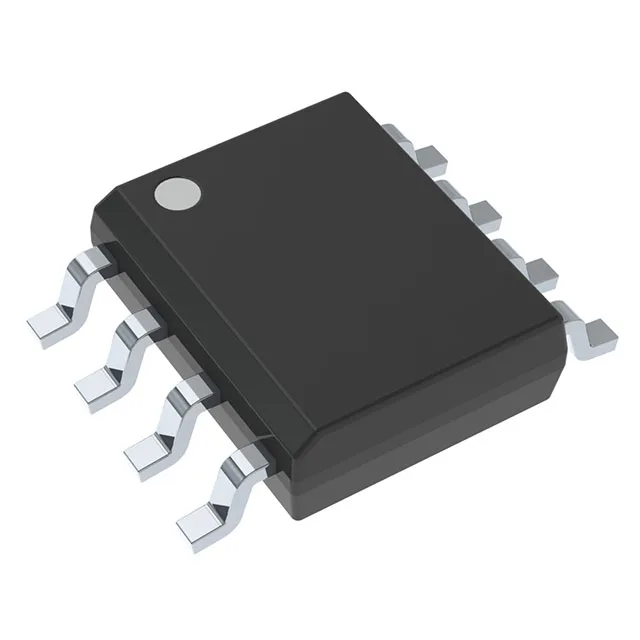
Active production, low-power precision for battery and sensor front-ends
The LMC6061AIMX/NOPB: Its 0.035 V/µs slew rate and 100 kHz gain-bandwidth product tell you this is a precision low-frequency amplifier, not a high-speed buffer — the output can swing 3.5 V in 100 µs, which sets the ceiling for AC signal conditioning in the sub-20 kHz band.
Input bias and offset — what they mean for a photodiode or thermocouple front-end
Input bias current is 0.01 pA typical — that is 10 fA, low enough that a photodiode amplifier with a 10 MΩ feedback resistor sees only 0.1 µV of voltage error from bias current, negligible compared to the 100 µV input offset voltage. The 100 µV input offset defines the DC accuracy floor — for a thermocouple amplifying a 40 µV/°C signal, a 100 µV offset corresponds to a 2.5 °C error at the ADC before any calibration trim.
Supply flexibility and rail-to-rail output
Supply span from 4.5 V to 15.5 V means it works on a single 5 V rail (common in industrial 24 V-to-5 V systems) or on dual ±5 V supplies — the rail-to-rail output lets the signal swing to within millivolts of each rail, recovering the full dynamic range that a traditional bipolar output would lose. The 8-SOIC package (3.90 mm width, 0.154" body) is a standard footprint for two-layer boards — no fine-pitch fan-out required, and the 1.27 mm pin pitch is hand-solderable for prototype rework.
Temperature grade and compliance
ROHS3 compliant (no exemptions) — ships globally without restriction under EU RoHS directives; no date-code sorting needed for restricted-substance compliance.