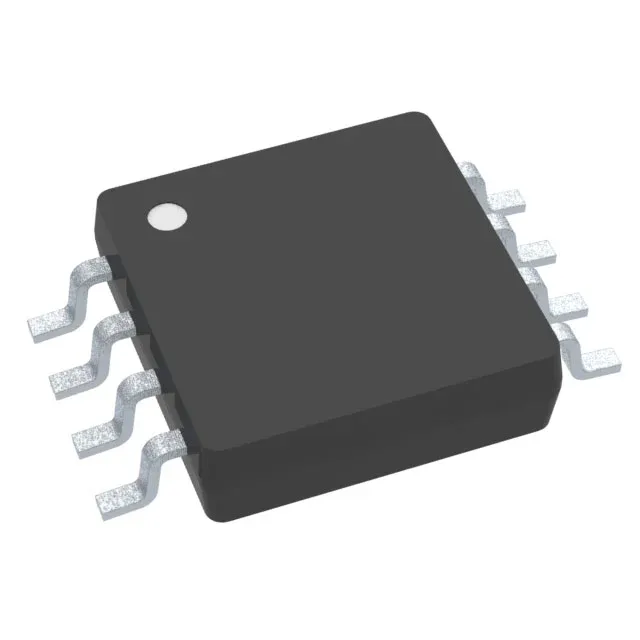
What the local/remote sensing means for your board
The LM95231CIMM/NOPB is a digital temperature sensor from the TruTherm™ series that measures its own die temperature (local) and the temperature of an external diode-connected transistor (remote). This means you can monitor the junction temperature of a CPU, FPGA, or power MOSFET without placing a sensor right on the hot component — the remote diode is the sense element, and the sensor reads it over a pair of PCB traces. Local resolution is 9 bits (0.5°C per LSB), remote resolution is 12 bits (0.0625°C per LSB). The remote channel gives you finer granularity for tracking thermal runaway in a power device.
Supply, accuracy, and temperature range
Accuracy is ±3°C across the full range. That is a system-level spec — the total error includes the sensor's own offset, the remote diode's ideality factor mismatch, and the PCB trace resistance. For a server motherboard monitoring a CPU, this is adequate for fan-speed control and overtemperature warning, but not for precision calibration.
SMBus interface and programmable features
Communication is over the SMBus — a two-wire interface compatible with I²C but with stricter timing and a timeout. The sensor supports One-Shot conversion (take a single reading then go back to standby), programmable resolution (trade speed for precision), and both Shutdown and Standby modes to reduce power when not actively measuring.