Active sensor, RoHS flag — two decisions, one part
The LM90CIMM: RoHS non-compliant status means this part cannot ship into EU RoHS-regulated markets without an exemption. For legacy assemblies that already have a Pb exemption or are in regions without RoHS enforcement, that is not a blocker — but any BOM engineer adding it to a new design under EU/REACH rules needs an explicit exemption letter or a drop-in alternative.
8-bit local, 11-bit remote — where the resolution matters
Local channel reads the board ambient at 8-bit resolution (1°C LSB typical) — coarse but adequate for overtemperature shutdown or fan control. The remote channel resolves to 11 bits (0.125°C LSB), which is the channel you route to an external diode on a CPU, FPGA, or power module for fine-grained thermal monitoring. Accuracy is ±4°C across the full range — this is not a precision metrology part. It is a guard-band sensor: set the programmable limit a few degrees below the absolute max junction temperature and let the output switch or shutdown mode catch the overtemp event before the silicon reaches critical. Supply range is tight at 3.0–3.6 V — the sensor runs cleanly off a 3.3 V rail but has no headroom for a 2.5 V or 5 V bus. The I²C/SMBUS interface operates at the same Vdd, so the pull-up resistors and bus voltage must match.
0°C to 125°C operating — indoor and industrial box only
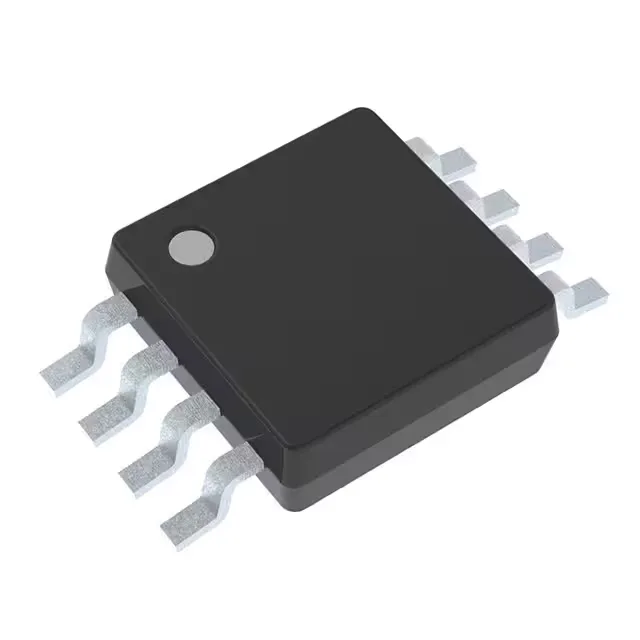
Operating temperature range is 0°C to 125°C, with the local and remote sensing linearised from 0°C to 85°C. That covers most indoor electronics, telecom cabinets, and industrial control enclosures — but it excludes outdoor cold-start below freezing and under-hood automotive applications. The 8-VSSOP package (MSOP-8, 3.00 mm width) is a standard footprint for low-pin-count sensors. Bulk packaging means no reel or tape — the parts ship in tubes or trays, which is typical for prototype runs or small-series production but less efficient for high-volume pick-and-place lines that expect tape-and-reel.