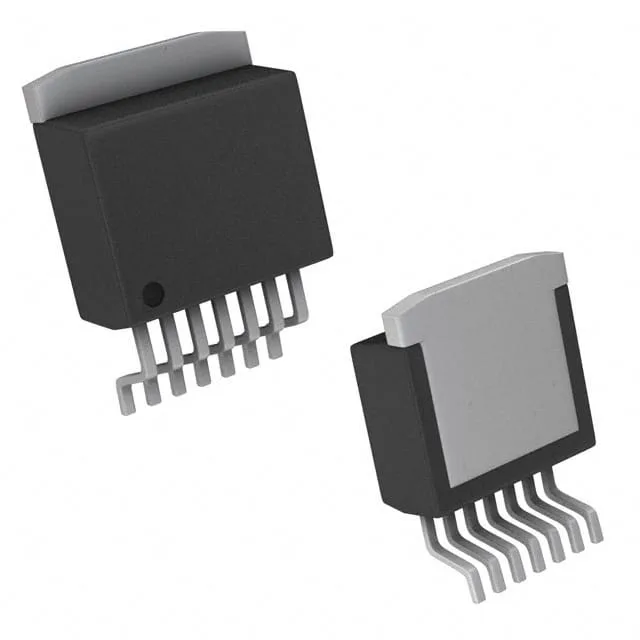
Package and thermal story
The LM9070SX/NOPB lives in a DDPAK/TO-263-7 package — a surface-mount cousin of the TO-220 with an exposed tab on the bottom. That tab is the thermal path: solder it to a copper plane on the board and the junction-to-ambient resistance drops from the free-air figure to something you can actually use at 250 mA. The 7-lead count includes the tab as the 7th connection, so the footprint is non-standard for a 3-pin regulator — verify the pad layout against the TO-263-7 land pattern before committing the board.
Dropout and headroom — the real limit
Rated for 250 mA continuous output at a fixed 5 V. Drop the input below that and the output follows it down, no longer a clean 5 V rail. Quiescent current sits at 4 mA — not a micropower part, but reasonable for a linear regulator that stays on continuously in a vehicle body controller or industrial control module. The 50 mA supply maximum includes the output current plus the internal bias, so the total drawn from the input rail is the load plus that overhead.
Ripple rejection and protection — what keeps the rail clean and alive
Power supply rejection ratio is 60 dB at 120 Hz — that is the fundamental ripple frequency from a full-wave rectified line. 60 dB means the ripple on the output is about 0.1 % of the ripple on the input, so a few hundred millivolts of 120 Hz buzz on the input rail gets knocked down to negligible levels. At higher frequencies the PSRR rolls off, so upstream switching noise above a few kilohertz will pass through unless filtered ahead of the LDO. The protection suite covers the common ways a linear regulator dies in a vehicle or industrial environment: over-temperature shuts it down before the junction exceeds the silicon limit; over-voltage clamps or shuts down if the input spikes above the safe range; reverse polarity blocks current flow when the battery is hooked up backwards; and short-circuit current limiting protects the pass transistor and the load wiring. The Enable pin lets a microcontroller or switch pull the regulator into shutdown, dropping the quiescent current to near zero when the load is idle.
Temperature grade and sourcing posture
Texas Instruments lists the product status as Active, with ROHS3 compliance, so no end-of-life or last-time-buy pressure on this order code.