Active production — what it means for a BOM line
The LM5041MTC/NOPB: This is a current-production part you can design into a new build or replenish an existing BOM without worrying about a last-time-buy window. The ROHS3 compliance means no exempt substances are sunsetting; the part ships with full TI material declaration. No PCN-driven respin risk from a RoHS exemption expiry.
Supply range and topology flexibility
The 15V to 90V Vcc range covers 24V and 48V industrial rails with margin — 48V nominal plus 20% transient sits at 57.6V, well inside the 90V abs-max. The controller also starts from a 15V bias rail, so a simple auxiliary winding or a small linear regulator can power it. Half-bridge and push-pull topology support means the same controller IC works for isolated and non-isolated designs. A half-bridge drives the primary of a transformer with a DC-blocking cap; push-pull uses a centre-tapped winding. Both are common in telecom brick converters and industrial auxiliary supplies. The function is Step-Up/Step-Down, which in this context means the controller regulates an output voltage that can be above, below, or inverted relative to the input — the actual conversion ratio depends on the transformer turns ratio and the duty cycle.
Switching frequency and synchronous rectification
The oscillator is programmable to 200kHz or 600kHz. At 200kHz the magnetics are larger but the switching losses are lower; at 600kHz the transformer and output inductor shrink by roughly 3× in volume, but the gate-drive losses and the dead-time accuracy become more critical. The clock sync input lets multiple LM5041s run from a single master oscillator, eliminating beat-frequency ripple in paralleled or multi-output designs. The synchronous rectifier output generates a complementary drive signal for the secondary-side FET. Replacing a Schottky catch diode with a low-Rds(on) FET typically recovers 3-5% efficiency in the 50-100W range, which matters for thermal management in a sealed enclosure.
Control features and temperature grade
Dead-time control, frequency control, and soft start are the three adjustments that shape the switching waveform. Dead-time prevents shoot-through in the half-bridge FETs; soft start limits the inrush current during startup; frequency control sets the oscillator timing. All three are accessible via external resistors and capacitors — no digital programming required. The -40°C to 125°C junction temperature range is the full industrial grade. The controller can sit in an outdoor telecom cabinet or a factory-floor enclosure without active cooling, as long as the total power dissipation stays within the package thermal limits.
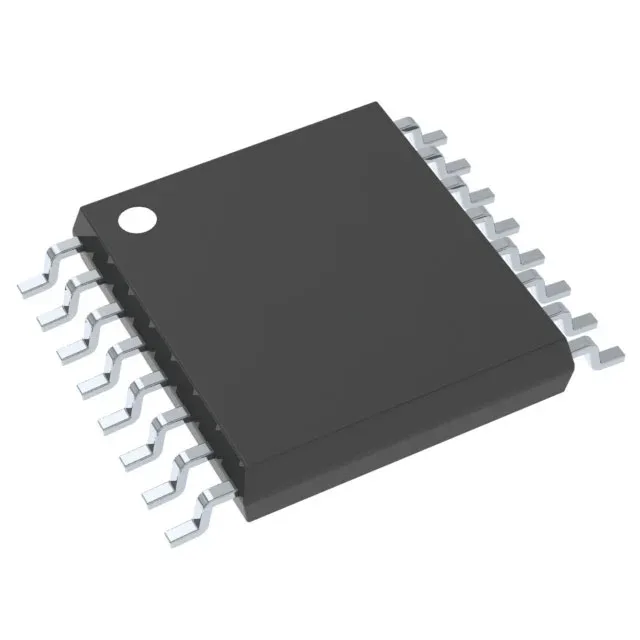
The 16-TSSOP package has a 4.4mm body width and 0.65mm pin pitch — a standard 4-layer board with 0.2mm traces and 0.3mm vias handles the fan-out. No exposed pad; thermal dissipation goes through the pins and the copper plane on the top layer. The part ships in a tube, not tape-and-reel.