What the 105V supply range means for your bus
The LM5039MH/NOPB runs from a 13V to 105V supply rail — that covers 24V industrial, 48V telecom, and 72V railway auxiliary buses without an external pre-regulator. The 105V upper end also handles the 100V transient peaks common on 48V PoE and battery-backed rails. Because the controller is a half-bridge topology with step-up/step-down capability, it can regulate an output voltage that sits above or below the input. That makes it a fit for wide-input-range designs where the bus voltage swings — say, a 36V–72V telecom input that must produce a 48V or 12V output.
Switching frequency and the transformer trade-off
The oscillator runs at either 200kHz or 500kHz — the lower frequency keeps switching losses down and lets you use a larger, more efficient transformer core; the higher frequency shrinks the magnetics at the cost of higher FET gate-drive losses. Both frequencies are set by a single resistor to ground, no external capacitor needed. Clock Sync lets you synchronise multiple LM5039 controllers to the same external clock — useful when paralleling half-bridge stages or when the switching noise must sit at a known frequency to avoid beating with the downstream converter's switching.
Package and board-fit for the rework bench
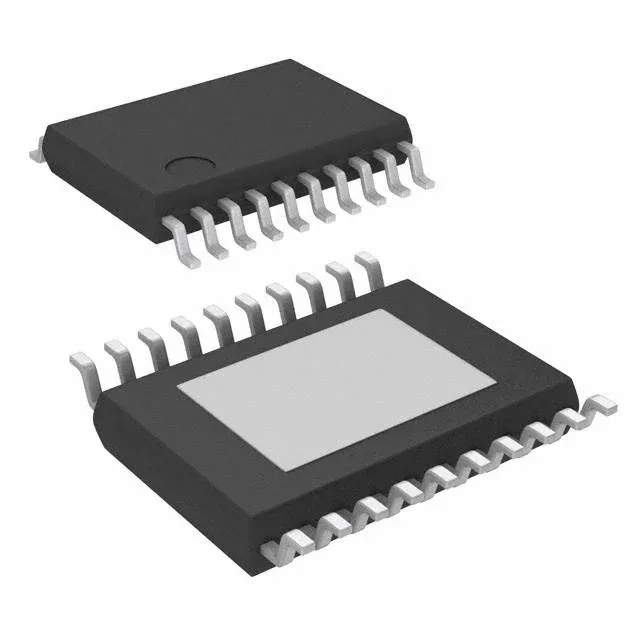
The 20-PowerTSSOP (4.40mm width) has an exposed thermal pad on the bottom — the HTSSOP package. The pad also makes hand-rework straightforward with a hot-air station if the board has a bottom-side via array to wick heat away. The output is a single transistor driver with isolation-capable positive configuration — it drives the primary-side MOSFETs through a pulse transformer or an optocoupler for galvanic isolation. Synchronous rectification is built in, so the secondary-side SR FETs can be driven directly without an extra controller.
Lifecycle and compliance at a glance
It is ROHS3 compliant (no exemptions that are phasing out), so it fits current EU and China RoHS requirements without a waiver.