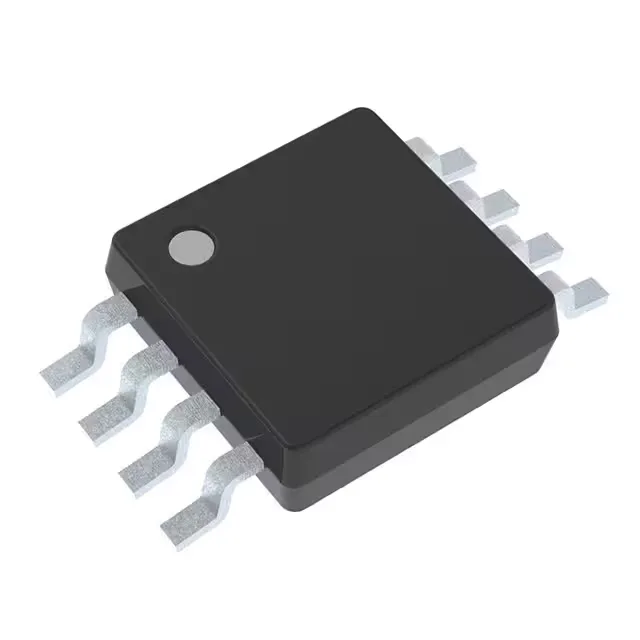
Controller architecture and switching limits
The LM5021MM-2 is a current-mode PWM controller supporting both flyback and forward topologies — the two dominant isolated offline converter architectures for auxiliary and bias supplies up to roughly 100 W. Maximum duty cycle is clamped at 50%, which limits transformer flux imbalance in current-mode flyback designs and avoids saturation during startup transients. Switching frequency reaches up to 1 MHz, enabling small magnetics and ceramic output capacitors, though above 500 kHz the layout parasitics (gate-drive loop inductance, transformer interwinding capacitance) become the limiting factor for EMI and efficiency. No internal power switch — the controller drives an external MOSFET via the OUT pin, giving the designer freedom to select the Rds(on) and Qg that match the power stage, but adding a gate-drive resistor and a snubber network to the BOM.
Supply range, startup, and protection
Vcc operates from 8 V to 30 V, wide enough for universal-input offline supplies where the bias winding delivers 12–18 V after startup, with margin for load transients. Startup threshold is 20 V — the controller remains off until the startup resistor charges the Vcc capacitor past this level, then the UVLO hysteresis keeps it running down to about 8 V. On-chip fault protection includes cycle-by-cycle current limiting and overload detection, which together prevent the transformer from saturating and limit output power during a short circuit. Control features — frequency control (for spread-spectrum EMI reduction), soft-start (for controlled output rise), and synchronization input (for multi-phase or interleaved converters) — are available on dedicated pins, though the 8-pin package limits how many can be used simultaneously.
Package, thermal, and board-fit
Supplied in Bulk packaging — loose units in an anti-static tube or bag, typical for prototype quantities and low-volume production. For reel packaging, check the alternate ordering code (LM5021MM-2/NOPB for RoHS-compliant versions on tape-and-reel).
Lifecycle and compliance reality
New designs can proceed without an obsolescence timeline. RoHS status is non-compliant. It may still be used under the RoHS exemption for lead in high-melting-temperature solders (exemption 7(c)-I) or in military/aerospace applications, but EU-compliant designs should verify the exemption applicability or migrate to the LM5021MM-2/NOPB variant.
For buyers with a BOM line specifying LM5021MM-2, the active lifecycle means no urgency to qualify an alternative. If a RoHS-compliant substitute is required, the LM5021MM-2/NOPB (lead-free, tape-and-reel) is the direct TI counterpart.