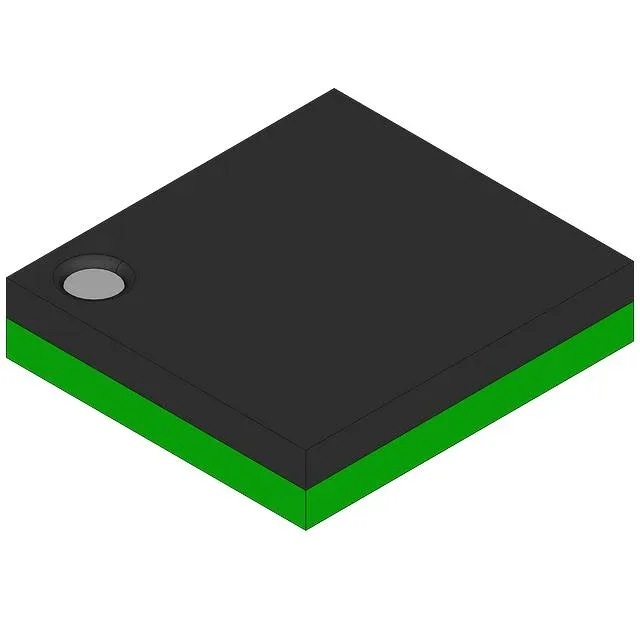
1.3 W mono plus stereo headphone driver in a single BGA
The Texas Instruments LM4946TM/NOPB is a Boomer® Class D audio amplifier that packs a 1.3 W mono speaker channel (into 8 Ω) and a separate stereo headphone output (85 mW per channel into 32 Ω) into a single 25-bump WFBGA (25-uSMD).
Digital volume and control — I²C and SPI on the same die
Instead of analog pots or PWM-duty-cycle volume, the LM4946TM/NOPB accepts I²C or SPI commands for volume, mute, shutdown, and depop control. That saves board area and lets a host MCU adjust gain on the fly without a codec. The 3D and thermal protection features are also gated through the same serial interface. For a firmware engineer, the I²C target address and SPI mode selection live in the datasheet's register map; the depop timing defaults work for most 8 Ω loads but can be stretched via register writes if a larger coupling cap is used.
The 2.7 V minimum supply means this part runs through the full discharge curve of a Li-ion cell (down to ~3.0 V with margin). At 5.5 V max it also tolerates a 5 V USB rail. The 1.3 W into 8 Ω is the Class D efficiency story — at 3.6 V typical you get useful output without a heatsink, because the switching output stage dissipates far less than a linear Class AB amp at the same power. The headphone channel is a separate Class AB output rated for 32 Ω loads; driving 16 Ω headphones will increase distortion, so stick to 32 Ω or higher for clean audio.
Package reality — 25-bump WFBGA
The 25-WFBGA (supplier package 25-uSMD) is a fine-pitch BGA with 0.4 mm or 0.5 mm ball pitch depending on the variant — confirm the ball pitch from the mechanical drawing before committing the PCB footprint. It is surface-mount only; no socket exists.
Lifecycle — active with no LTB signal
The ROHS3 compliance covers current EU exemption rules. The /NOPB suffix indicates lead-free (RoHS) finish; the base LM4946TM without the suffix is the tin-lead version, now largely superseded by this lead-free variant.