4.096 V shunt reference — precision anchor for the analog rail
The LM4050CIM3X-4.1 is a precision shunt voltage reference from Texas Instruments, delivering a fixed 4.096 V output with ±0.5% initial tolerance. That 4.096 V value is not arbitrary — it maps cleanly into a 12-bit ADC's LSB at 1 mV per count, making this part a natural fit for data-acquisition and instrumentation rails where the reference voltage directly scales the conversion result. As a shunt reference, it behaves like a precision Zener diode: it sinks current through a bias resistor from a higher supply rail and regulates the voltage across itself. The 15 mA maximum output current sets the load-driving ceiling — the external resistor must be sized so the total current (load plus the 73 µA minimum cathode current) stays within this limit across the supply and temperature range.
Temperature drift and noise — the signal-chain budget
Temperature coefficient is 50 ppm/°C. This wideband noise integrates across the signal bandwidth; for a 1 kHz measurement bandwidth, the contribution is about 2.9 µVrms, well below a 12-bit LSB at 4.096 V, but it becomes relevant in 16-bit+ systems where the reference noise floor can dominate the converter's SNR.
The RoHS status is marked as non-compliant. For builds requiring full RoHS exemption or Pb-free assembly, verify the date-code and the specific exemption claim against the TI documentation — this is a flag for the compliance engineer to check, not a showstopper if the BOM already accommodates the exemption.
SOT-23-3 footprint — board-fit and sourcing
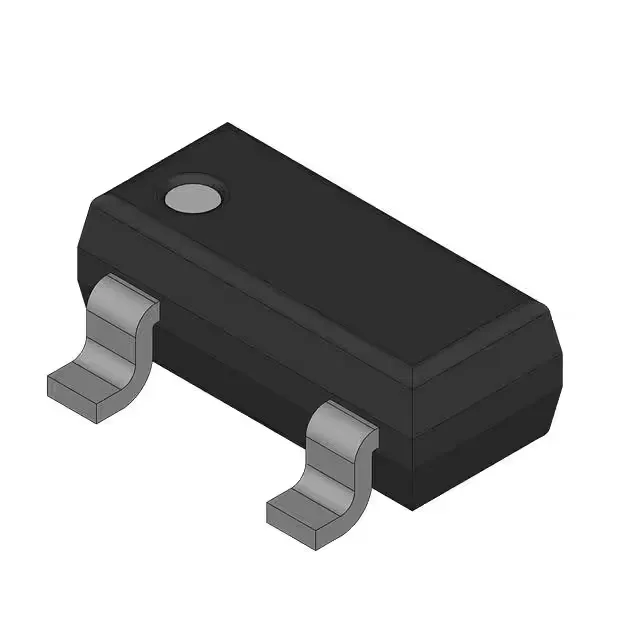
The part comes in the SOT-23-3 package, also listed as TO-236-3 / SC-59. The three-pin SOT-23 footprint is a standard across the industry — the same land pattern serves the LM4040 series and dozens of other shunt references, so a board laid out for this part can often accept a second-source candidate without a layout change. Supplied in Bulk rather than tape-and-reel. For high-volume pick-and-place, a reel or cut-tape option may be more efficient; confirm the packaging preference at RFQ time to avoid a manual-loading step on the line.